82 Best Framer Portfolio Website Examples

At a glance, this grid is almost all black and white. Headlines sit on top, work sits below, and colour rarely shows up at all. That structure, confirmed when I ran the best Framer portfolio websites through Claude, is the dominant pattern here: text first, imagery second. But the detail that makes it work is restraint in the headline itself. The examples below show what a short, specific line does. A vague tagline wastes the prime space Framer design portfolio sites need most.
Category
Platform
Style
 Mimic this
This portfolio site uses a three-part badge system in the hero—"Digital Solutions Architect" in black, "Austin" in outline—to break up the value proposition typography.
 Mimic this
This product designer portfolio pairs iPhone mockups fanned across an organic blob with serif-italicized "Human-Centered" in the headline to signal editorial craft alongside digital work.
 Mimic this
This designer portfolio uses a grayscale hero portrait with white overlay text and displays selected work as a 2-column grid mixing product shots and design mockups.
 Mimic this
This photography portfolio site pairs moody dark layouts with romantic serif typography and overlays category labels directly on stacked thumbnail grids.
 Mimic this
This link-in-bio site uses monospace all-caps typography, washi tape corner graphics, and a dark green grid background to layer scrapbook aesthetics with brutalist design.
 Mimic this
This art director portfolio leads with an oversized custom "DII" logotype and embeds a real-time timestamp in the navigation bar.
 Mimic this
This industrial designer portfolio uses polaroid-style tilted photos with white borders and a "Designer Since Day 1" timeline spanning childhood to present.
 Mimic this
This product designer portfolio showcases six projects in an asymmetric grid, each in a soft pastel card, with no titles—only screenshots.
 Mimic this
This designer portfolio uses serif-italic styling within the hero headline to contrast "UI/UX Designer" against sans-serif "Google Certified," creating typographic hierarchy through font choice rather than size alone.
 Mimic this
This sports media production site leads with "BEYOND THE SCORE" and uses a three-column image grid with overlay text to showcase athlete coverage across different sports.
 Mimic this
This product designer portfolio opens with a full-width hero featuring a portrait and quote about "every pixel is a decision," then displays fintech case studies under frosted glass overlays.
 Mimic this
This creative director portfolio uses a two-column hero with surreal chrome-sunglasses portrait art and monospaced labels like "ALL THE THINGS I LOVE TO DO..."
 Mimic this
This photographer portfolio uses bracket notation "[ABOUT ME]", "[05]" throughout and lays out a gallery as an unequal five-column masonry strip.
 Mimic this
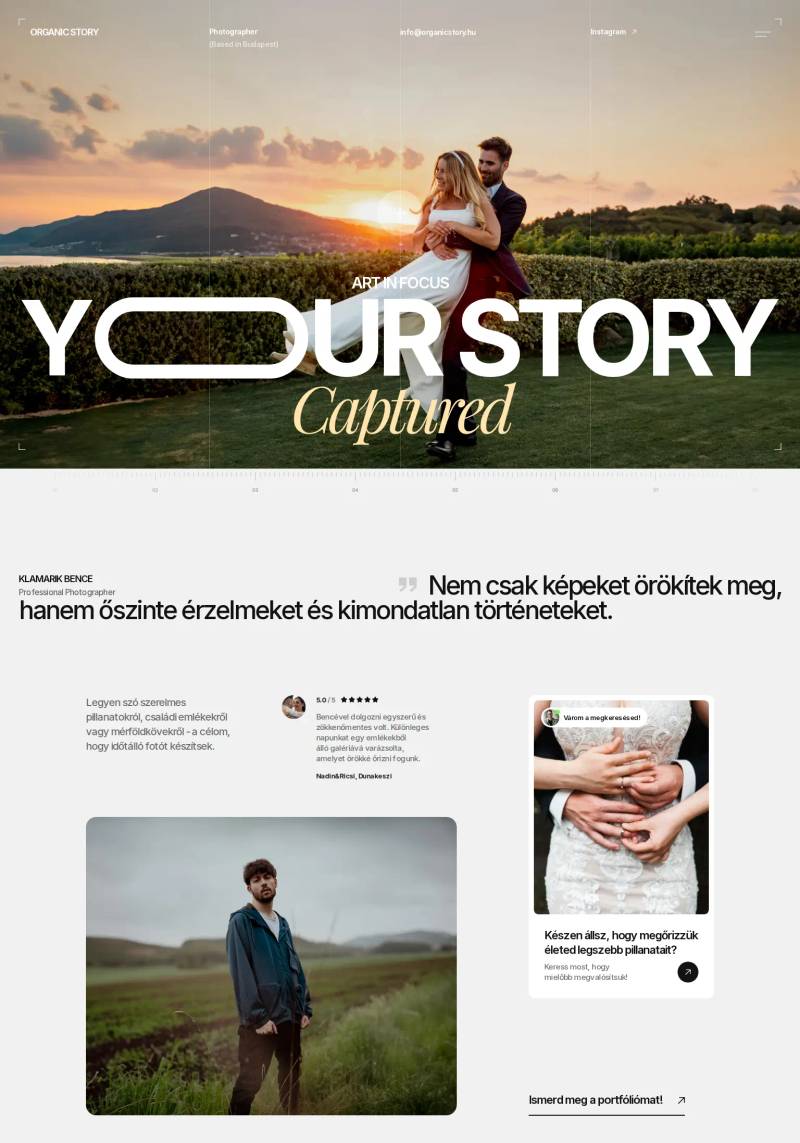
This wedding photographer site replaces the "O" in "YOUR STORY" with a circular cropped headshot of the photographer himself.
 Mimic this
This photographer portfolio site centers a massive oversized "M" in the hero headline to visually anchor "YOUR MOMENTS" while a film-strip divider echoes darkroom aesthetics.
 Mimic this
This 3D motion design portfolio sells freelance services with vintage tech renders and "makes products dance. Your one-stop shop, with more disco."
 Mimic this
This photographer portfolio uses a split hero layout with the photographer pictured shooting, pairing serif headings with scattered polaroid-style image collages in the "Why Work With Me?" section.
 Mimic this
This brand strategy portfolio leads with an ultra-bold lowercase wordmark and replaces the hero's head with clouds, anchoring credibility through client logos and section numbers.
 Mimic this
This product designer portfolio scatters six skill icons around the hero with hand-drawn arrows, then leads with "5 years of building products that work so users don't have to."
 Mimic this
This brand designer portfolio uses a dark navy hero with warm-lit portrait photography and numbered service items (#01 Brand Strategy, #02 Brand Identity Design, etc.) to structure offerings.
 Mimic this
This video editor portfolio uses serif headings and gold button borders to position freelance editing as premium, showcasing "27.6 Million+ views" across colorful project thumbnails on dark.
 Mimic this
This drone photography service site anchors its value prop in a serif-and-orange layout, opening with "Elevate Your Business With Professional Drone Photography & Video."
 Mimic this
This product designer portfolio uses hand-drawn yellow-green highlight boxes behind key words to annotate the hero section.
 Mimic this
This designer portfolio opens with an italic serif headline "I'm Emanuele, I design to make a difference" paired with purple-accented keywords and case study cards featuring product images.
 Mimic this
This newborn photography site leads with "Award Winning First Year Photographer" in serif italic and anchors trust through "safely, gently, and with love" in the subtext.
 Mimic this
This designer portfolio uses a portrait collage of floating UI mockup cards and "Their Words Not Mine" testimonials to position freelance UI/UX work.
 Mimic this
This photography portfolio overlaps a massive H1 across a three-column image grid and uses a single green dot to label "AVAILABLE FOR WORK."
 Mimic this
This freelance designer portfolio uses a floating rounded card layout with neon yellow CTAs and stacked social proof badges to establish credibility immediately.
 Mimic this
This product designer portfolio uses a single-column card stack with project thumbnails, skill tags, and client testimonials to present Luna Rose's work.
 Mimic this
This communication designer portfolio uses a grid paper background and scatters tilted photos with rotating badge stickers across the hero collage.
Design Data
The colors, fonts, and layout choices used across 85 Framer portfolio websites.
Background color
How dark or light the page background is (background luminance).
- White / near white 54.1% (46)
- Black / near black 32.9% (28)
- Dark 5.9% (5)
- Mid-tone 3.5% (3)
- Light 3.5% (3)
Accent color
The color of each site's primary button, measured from its code (accent hue family).
- Black, white & gray 45.2% (33)
- Amber / orange 17.8% (13)
- Red 11% (8)
- Green 8.2% (6)
- Purple 6.8% (5)
- Teal / cyan 5.5% (4)
- Blue 4.1% (3)
- Pink 1.4% (1)
Hero layout
How the top section arranges its headline and imagery.
- Text above full-width media 39.7% (29)
- Centered text 24.7% (18)
- Text over a full-width image 17.8% (13)
- Asymmetric 8.2% (6)
- Text left, image right 6.8% (5)
Hero imagery
The kind of visual the top section leads with.
- Photography 36.9% (31)
- No imagery 23.8% (20)
- Illustration 19% (16)
- Video 8.3% (7)
- Product screenshot 7.1% (6)
Font combination
How heading and body typefaces pair (serif vs. sans-serif).
- All sans-serif 71.4% (25)
- Serif headings, sans-serif body 28.6% (10)
Color intensity
How colorful the palette is, from black-and-white to bold color (saturation).
- Black & white 49.4% (42)
- Soft, muted color 45.9% (39)
- Bold, vivid color 4.7% (4)
Dark mode support
Sites whose code adapts to the visitor's light/dark preference (prefers-color-scheme).
- Yes 14.6% (6)
- No 85.4% (35)
Most-used fonts
The typeface each site leads with, read from its live CSS.
- Manrope 11.4% (4)
- Inter 11.4% (4)
- Inter-SemiBold 8.6% (3)
- DM Sans 5.7% (2)
- Satoshi Black 2.9% (1)
Percentages are the share of sites where each trait could be measured, with counts in parentheses. Last updated August 2026.
Video heroes are seven times more common in Framer portfolio design
Video hero media shows up in 8.3% of measured Framer portfolios, compared with just 1.2% across the wider gallery. That is seven sites out of the eighty-four measured for hero media, a small absolute number but a huge relative jump, and it signals something real about this niche: portfolio builders on Framer are willing to spend load time and production effort on motion because the platform makes embedding video frictionless. For anyone assembling Framer portfolio websites, this is the platform where a showreel or motion clip in the hero is a legitimate default, not an outlier choice reserved for videographers. That instinct carries over cleanly to the Framer Videographer Websites and Framer Game Designer Portfolio Websites sub-niches, where motion-first heroes are even more expected.
Copy stacked above the fold beats every other hero layout
Stacked copy over media appears in 39.7% of measured heroes here, against 17% gallery-wide, making it this page’s dominant layout by a wide margin over centered (24.7%) or full-bleed overlay (17.8%) arrangements. Stacking headline text above imagery gives designers a clean vertical read on both desktop and mobile without fighting for space against a photo or illustration, which explains why it dominates a niche built around showcasing visual work. Michael Ameyaw and Douceur
 both use photography-led heroes that follow this stacked logic, letting the image breathe below a settled headline. Anyone studying best Framer portfolio website examples for layout structure should treat stacked copy as the safe, tested starting point rather than centered text.
Monochrome color schemes are now the majority approach
Monochrome palettes cover 49.4% of this page’s sites, nearly a majority, versus 29.7% across the whole gallery. That is a striking swing toward restraint: roughly half of these portfolios strip color out entirely and let typography, contrast, and imagery carry the design. ACEDIA PICTURES , Cynthia Hua
 , Mumin Wani
 , and Anslea Askew
 all commit fully to black-and-white palettes with black or white buttons, and the pattern holds whether the background is near-white or near-black. This restraint pairs naturally with the near-white and near-black backgrounds that dominate the wider set, since a monochrome palette needs almost no additional decision-making about accent hues. Designers building portfolios for Framer Design Portfolio Websites or Framer Photography Websites can lean on this: cutting color entirely reads as more confident than picking a timid accent.