49 Best Shopify Supplements Website Examples

You’re either opening with a big lifestyle photo or putting the product front and center. I ran the best Shopify supplements websites through Claude. They overwhelmingly pick the same layout: headline on the left, product shot on the right. That split hero is worth copying anywhere you sell something physical. But the trust badges and subscription nudges stacked underneath are specific to supplements. Compare the examples below and notice how each site handles that second layer differently.
Category
Platform
Style
 Mimic this
This fiber supplement site leads with "#1 Product of the day" credibility and sells a subscription model with "10% discount on every recurring order" prominently displayed.
 Mimic this
This wellness supplement site uses fashion editorial photography and "MENTAL WELLNESS, REDEFINED." as hero copy, positioning nootropics as luxury lifestyle.
 Mimic this
This personalized nutrition site sells 3D-printed vitamin stacks customized through a quiz, using a warm terracotta gradient hero and serif typography in navy.
 Mimic this
This vitamin supplement site pairs hands holding bottles with a cream-to-teal gradient and leads with "Doctor-Developed Vitamins with Benefits You'll Feel."
 Mimic this
This natural supplements e-commerce site leads with "The Natural Way to Feel Your Best—From the Inside Out" and uses overlapping amber glass bottles and benefit badges like "Brain Fog" and "Gut Health" to anchor product discovery.
 Mimic this
This jet lag supplement site opens with "Jet lag is a choice" and stacks product shots, app interface, and athlete testimonials in a two-column hero.
 Mimic this
This plant-based protein site arranges product categories in a four-column grid with lifestyle photos and stacks a split-layout Autoship section with circular benefit icons.
 Mimic this
This French supplement e-commerce site uses a scrolling orange ticker for stacked promotions and anchors product cards with colored benefit tags like "Sommeil réparateur" and "Sans sucres."
 Mimic this
This supplements site uses a two-column hero pairing product lifestyle photography with "30 million+ Bites enjoyed" social proof and time-segmented results stats (69%-79% improvement metrics).
 Mimic this
This men's supplement site leads with "STAY IN YOUR PRIME" and stacks trust badges (Made in USA / Free Shipping / Money Back Guarantee) beneath an all-caps hero headline.
 Mimic this
This functional wellness DTC site organizes products by benefit—Focus, Restore, Sleep, Hydrate—in a four-column grid with color-coded card backgrounds.
 Mimic this
This children's supplements shop uses a split hero with emoji-filled product copy ("good gut bugs 🌱 & smooth moves 💩") and a scrolling trust marquee featuring "Mum - Founded" and "Australian Made."
 Mimic this
This plant-based protein site leads with mixed typography—italic "Delicious" paired with bold sans-serif product copy—and repeats a marquee promo code banner across the top.
 Mimic this
This women's supplement site headlines "see-results vitamins. powered by evidence based ingredients." with a lime-green CTA and a scrolling trust banner listing clinical credentials.
 Mimic this
This frozen supplements shop leads with a split hero—serif headline paired with a hand holding vibrant popsicle-like tubes against a cream background.
 Mimic this
This health supplement site sells green powder with a split layout pairing lifestyle photography against benefit callouts with circular green icons.
 Mimic this
This wellness supplement site leads with a mosaic hero grid mixing product packaging, food prep, and lifestyle imagery beneath "Nourish your body naturally with Noode."
 Mimic this
This protein supplement site uses a split hero with serif headlines, colorful gradient product photography, and a scrolling top ticker announcing restocks and shipping thresholds.
 Mimic this
This functional mushroom supplement site uses a marquee ticker with product claims ("Shrooms That Really Work," "No Fillers, Just Fungi") anchoring the hero.
 Mimic this
This meal replacement shop uses sky-blue hero section with inline product imagery, accordion-expandable use cases, and floating annotation badges on lifestyle photography.
 Mimic this
This plant-based nutrition site uses a thin promotional banner, ingredient trust badges, and press logos to build credibility before showing product cards.
 Mimic this
This natural sweetener brand site uses a split-layout quiz section pairing product photography with a cream-colored content block to segment new versus returning customers.
 Mimic this
This supplement e-commerce site leads with "Hormone Balance IN ALL STAGES OF LIFE" over a woman holding the product, then scrolls through a trust bar of certifications before showcasing best-selling DIM variants.
 Mimic this
This hair vitamins ecommerce site contrasts "Forget Thin, Damaged Hair" against product badges that promise "LESS SHEDDING" and "FASTER GROWTH" in yellow pill shapes.
 Mimic this
This probiotic supplement site leads with scattered polaroid photos against a wooden texture, then stacks three "#1 trusted" badges before showing products.
 Mimic this
This supplement landing page sells an Ayurvedic powder through subscription tiers with "30% OFF" and "40% OFF" badges positioned as savings anchors.
 Mimic this
This Norwegian wellness e-commerce site anchors its hero with a classical marble statue and uses "One tree *planted* per order" as the sustainability hook.
 Mimic this
This fitness supplements site introduces products with full-width hero featuring oversized product bottles and a bold "MOJO 2.0" serif headline over dark geometric backgrounds.
 Mimic this
This plant-based nutrition site headlines "Trust" in cyan italics and organizes supplements, proteins, and meal plans as three equal product columns with pill-shaped cyan buttons.
 Mimic this
This supplements e-commerce site organizes products by health outcome (heart, brain, digestive, immune) rather than ingredient type, using circular category icons and tropical botanical imagery.
Design Data
The colors, fonts, and layout choices used across 49 Shopify supplements websites.
Background color
How dark or light the page background is (background luminance).
- White / near white 79.6% (39)
- Mid-tone 8.2% (4)
- Black / near black 6.1% (3)
- Light 4.1% (2)
- Dark 2% (1)
Accent color
The color of each site's primary button, measured from its code (accent hue family).
- Black, white & gray 30.4% (14)
- Amber / orange 21.7% (10)
- Green 13% (6)
- Teal / cyan 13% (6)
- Red 10.9% (5)
- Blue 6.5% (3)
- Pink 2.2% (1)
- Purple 2.2% (1)
Hero layout
How the top section arranges its headline and imagery.
- Text left, image right 55% (22)
- Text over a full-width image 25% (10)
- Image left, text right 12.5% (5)
- Asymmetric 5% (2)
- Text above full-width media 2.5% (1)
Hero imagery
The kind of visual the top section leads with.
- Photography 71.4% (35)
- Product screenshot 26.5% (13)
- Illustration 2% (1)
Color intensity
How colorful the palette is, from black-and-white to bold color (saturation).
- Soft, muted color 61.2% (30)
- Bold, vivid color 22.4% (11)
- Black & white 16.3% (8)
Percentages are the share of sites where each trait could be measured, with counts in parentheses. Last updated August 2026.
Best Shopify supplements website examples default to copy-left, image-right heroes
The split_copy_left arrangement dominates this page at 55%, more than double the wider gallery’s 24.6%. Twenty-two of the forty sites measured for hero layout put their headline and CTA on the left with a photo or product shot filling the right half. This is the safest layout for a supplements brand because it puts the value proposition, the ingredient claim, the “why buy this” line, in the reader’s first fixation point, then lets the visual close the sale. Noode and GoodOh
 both build their hero this way, pairing left-aligned copy with photography-led imagery, while KOR Shots
 uses the same split to frame a serif headline against product photography.
Backgrounds skew whiter here than the rest of Shopify
Near-white backgrounds appear on 79.6% of these sites, well above the 56% baseline across the full gallery. Only one site on this page runs a dark background, and near-black shows up on just three. Supplement brands lean on clinical whiteness to signal purity and lab-grade credibility, the same instinct that shows up in the muted, restrained palettes used by NUFYX and TruFibr
 , both of which pair white backgrounds with product-screenshot heroes rather than lifestyle photography. Maniq
 and Bully Max
 are the rare near-black exceptions, and both pair that darker mood with black-and-white palettes rather than color.
Product mockups appear twice as often as elsewhere
Hero media favors photography overall, at 71.4%, but product mockups reach 26.5% here versus 12.2% gallery-wide, meaning roughly one in four of these sites leads with a rendered bottle, pouch, or packaging shot instead of a lifestyle image. This fits a category where the product’s label design and format (capsule, powder, shot) carry the pitch. NUFYX, TruFibr, and 22 Days Nutrition all open with product-screenshot heroes, and Nourished
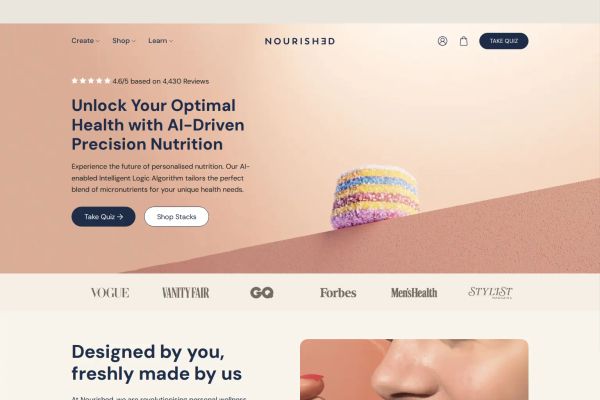 does the same, showing that letting the packaging itself be the hero image is a legitimate alternative to lifestyle photography rather than a fallback.
Accent color splits into two camps, neutral and amber
No single hue dominates the way white backgrounds do. Neutral accents lead at 30.4%, with amber close behind at 21.7%, and green and teal roughly tied at 13% each. This spread means color choice in this niche is genuinely open: Maniq commits to a strict black-and-white palette with black/white buttons, while H-Proof goes the opposite direction with a vivid palette and amber buttons. KOR Shots and Vitgo
 both use teal, showing that a cooler, clinical accent works just as well as amber’s warmer, more nutraceutical feel.