48 Best Canva Website Examples

You’re either building around a photo or building around a headline, and that choice shapes everything on a Canva site. I ran the best Canva websites through Claude, and most put the image on the left with the text on the right. That’s the opposite of what dominates elsewhere. The flipped layout keeps the photo from feeling like a backdrop and gives the words their own column. Skip the centered-text-over-image default and try a clean side-by-side split as you look through these examples.
Category
Platform
Style
 Mimic this
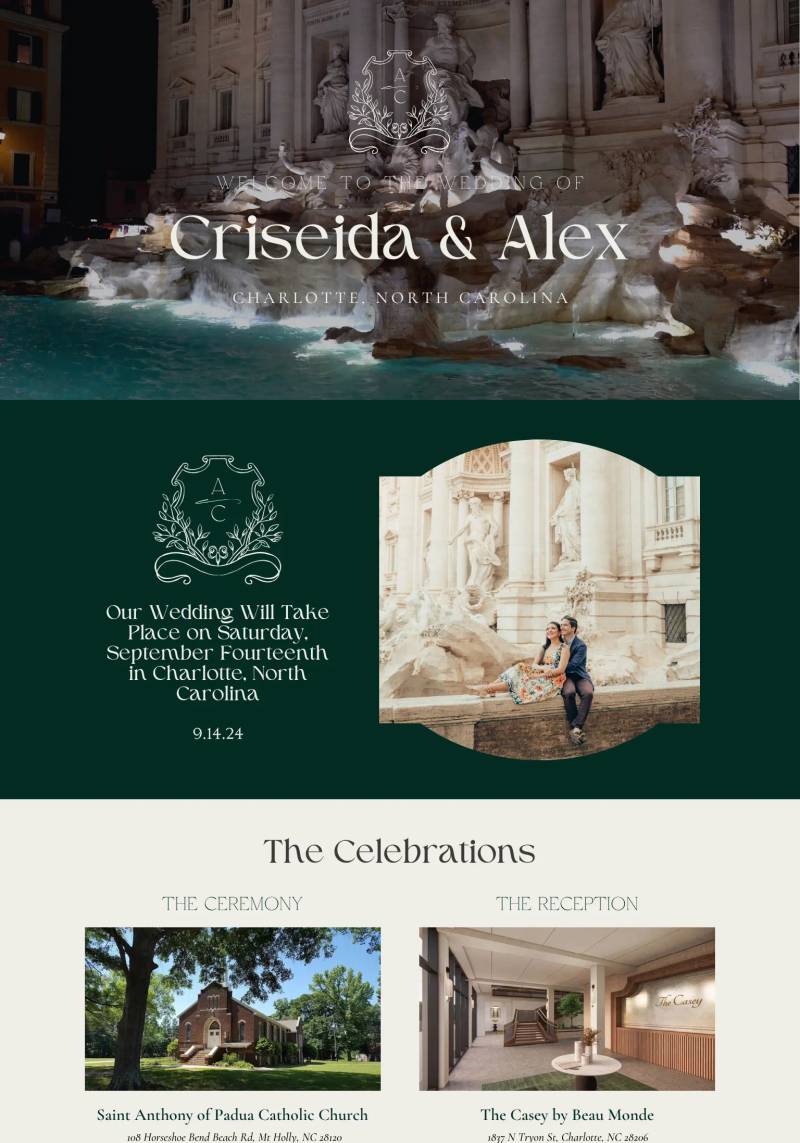
This wedding invitation site frames couple details in a scalloped-border photo and anchors the layout with a recurring monogram crest.
 Mimic this
This property styling site splits the layout asymmetrically with a minimalist sofa photograph left and stacked logo/tagline right, anchoring "We Create Dream Homes." in display serif.
 Mimic this
This UGC creator media kit uses arch-shaped photo masks and a warm beige palette to pitch "high quality, good lighting video in 5-7 days" with 29% conversion claims.
 Mimic this
This UGC creator portfolio pairs a monochromatic portrait with warm gold typography and arranges video projects in iPhone mockup grids labeled by content type.
 Mimic this
This wedding invitation site embeds a music player beneath a Spanish love quote and uses full-bleed couple photos with forest-green sections and dove illustrations.
 Mimic this
This Airbnb content creation site showcases portfolio work in iPhone mockups and uses overlapping circular portraits with scattered diamond ornaments.
 Mimic this
This social strategy agency site uses a retro western display font paired with a color palette strip showing "CHERRY," "NECTAR," "SUNFLOWER," and "ICING" hex codes.
 Mimic this
This medical tourism site uses neon pink/cyan holographic blobs and scattered monospaced plus-signs as ornamental dividers across dark backgrounds.
 Mimic this
This content creator portfolio stacks a serif name with social icons, then displays iPhone mockups at angles to showcase lifestyle and wellness content.
 Mimic this
This wedding website announces the couple's names in cursive script over a couple photo, with watercolor peach washes and hand-drawn florals framing event details in uppercase.
 Mimic this
This occupational therapy site pairs serif headings with italic script accents and decorative flourishes, anchoring "Kinship" as the emotional centerpiece of its hero message.
 Mimic this
This creative agency site uses organic blob shapes to mask hero imagery and positions "YOUR VISION, BEAUTIFULLY CRAFTED" in bold black serif against baby blue and white sections.
 Mimic this
This co-working site uses hand-drawn botanical illustrations and handwritten script fonts to soften productivity messaging around surf-camp amenities.
 Mimic this
This UGC creator portfolio overlaps portrait photos with hand-drawn doodle arrows and uses "LEVEL UP YOUR BRANDS SOCIALS" as the primary CTA.
 Mimic this
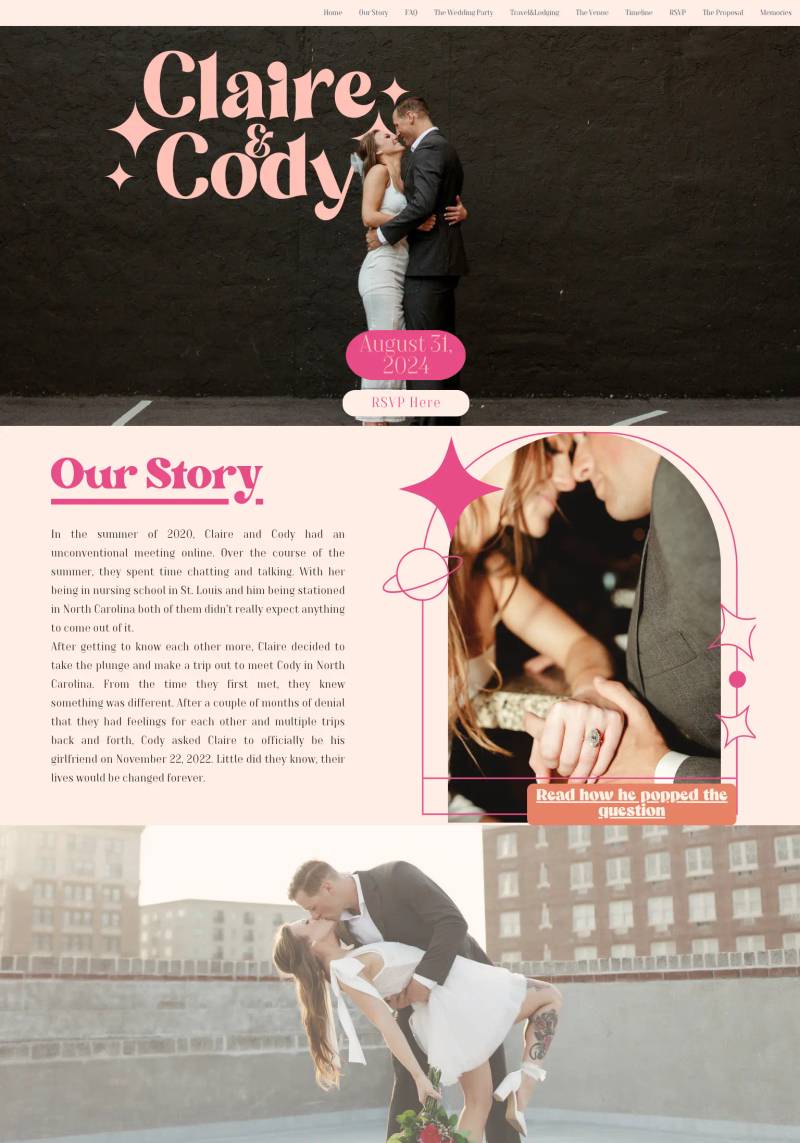
This wedding website frames couple photos with curved hot pink line art borders instead of rectangular frames, set against a peach background with retro serif display type.
 Mimic this
This wedding invitation site uses a clothesline with polaroid photos and watercolor blotches to frame the couple's 12-year story.
 Mimic this
This photography portfolio uses a muted periwinkle background with editorial serif headings and embeds personal family snapshots alongside professional work.
 Mimic this
This UGC creator portfolio organizes skincare and makeup content samples as horizontal scrollable video grids labeled with product names and content types.
 Mimic this
This wedding site centers the couple's names in a rotated diamond frame adorned with Chinese double-happiness symbols and flanking Indian elephants in coral-red.
 Mimic this
This personal training studio site opens with a barbell grip photo and pairs "FITNESS FROM THE INSIDE OUT" in yellow brush script against "BECAUSE YOU DO WHAT YOU BELIEVE" in outlined sans-serif.
 Mimic this
This badminton coaching site leads with "Hi! I'm Ali" in heavy serif type, then showcases three service cards with halftone photos and black drop shadows stacked in a grid.
 Mimic this
This wedding site uses a two-column hero with couple photo and script heading, then alternates sage-teal-mint background blocks for timeline and story sections.
 Mimic this
This performer portfolio overlaps rotated polaroid-style photos across the hero text and uses hand-drawn botanical illustrations as editorial decoration.
 Mimic this
This digital product site uses overlapping tilted product mockups paired with strikethrough pricing and "PLR Rights Included. Rebrand and Resell as Your Own!" as the core value proposition.
 Mimic this
This wedding save-the-date uses arch-shaped photo frames with watercolor lemon branches and "Recuerda es puntual!" to frame a Cabo San Lucas destination wedding.
 Mimic this
This UGC creator portfolio uses split-screen layouts with oval-clipped photos, sage green curved shapes, and handwritten-style script to introduce "Or Dom for short."
 Mimic this
This UGC creator portfolio pairs a split-screen hero—handwritten name overlapping a lavender-backgrounded portrait—with iPhone mockups showcasing content samples.
 Mimic this
This beauty services site leads with a full-bleed portrait and positions credentials—"14 years," "40 hands-on training sessions," "5000 international students"—as proof of expertise.
 Mimic this
This destination wedding site organizes guest logistics through pill-shaped link buttons and a black-and-white couple photo with serif typography overlay.
 Mimic this
This UGC creator portfolio mixes serif typography with decorative script and organizes video samples in a tight 4-column grid on cream backgrounds.
Design Data
The colors, fonts, and layout choices used across 48 Canva websites.
Background color
How dark or light the page background is (background luminance).
- White / near white 54.2% (26)
- Light 20.8% (10)
- Black / near black 12.5% (6)
- Mid-tone 8.3% (4)
- Dark 4.2% (2)
Accent color
The color of each site's primary button, measured from its code (accent hue family).
- Black, white & gray 52.6% (20)
- Amber / orange 21.1% (8)
- Red 15.8% (6)
- Pink 5.3% (2)
- Teal / cyan 2.6% (1)
- Blue 2.6% (1)
Hero layout
How the top section arranges its headline and imagery.
- Text over a full-width image 27.7% (13)
- Image left, text right 27.7% (13)
- Text left, image right 23.4% (11)
- Centered text 10.6% (5)
- Asymmetric 6.4% (3)
Hero imagery
The kind of visual the top section leads with.
- Photography 83.3% (40)
- Illustration 6.3% (3)
- No imagery 6.3% (3)
- 3D artwork 4.2% (2)
Color intensity
How colorful the palette is, from black-and-white to bold color (saturation).
- Soft, muted color 75% (36)
- Black & white 12.5% (6)
- Bold, vivid color 12.5% (6)
Dark mode support
Sites whose code adapts to the visitor's light/dark preference (prefers-color-scheme).
- Yes 0% (0)
- No 100% (29)
Percentages are the share of sites where each trait could be measured, with counts in parentheses. Last updated August 2026.
Best Canva website examples default to serif body text
Serif copy runs through 76.1% of this gallery’s measured sites, against just 7.5% across the wider gallery of Canva websites. That gap is the single clearest signal on this page: builders reaching for Canva’s website tool are pairing it with editorial-style type rather than the sans-serif defaults common elsewhere. C. Shore Mobile Notary Services and CYG Educational Solutions
 both lean on this serif-and-photography combination, giving otherwise simple service pages a printed, magazine-like body text feel that a plain sans stack would not deliver.
Split-right heroes tie the layout race
Hero layout splits three ways at the top, with split_copy_right and full_bleed_overlay tied at 27.7% each, and split_copy_left close behind at 23.4%. What stands out in Canva website design specifically is that split_copy_right alone claims 27.7% here versus 4.4% gallery-wide, a departure large enough to call a house style. Copy anchored left with imagery on the right suits Canva’s drag-and-drop hero blocks, and it shows in Blu Property Styling and Azalea Gardens Subdivision
 , both photography-led heroes with the text-first, image-second arrangement that this bucket describes.
Accent color skews neutral, not colorful
Neutral accents cover 52.6% of measured sites here, compared with 30.1% across the gallery as a whole. Paired with a muted saturation profile at 75%, the picture is consistent: Canva sites building for trust-based niches (notaries, pest control, cleaning services) pull back on color rather than push it forward. Cuartz Cleaning Services and Create that life
 both run black-and-white palettes on white backgrounds, and Candor Fitness
 carries the same restraint onto a near-black background, proving the neutral instinct holds regardless of luminance.
Dark mode is absent, and dark backgrounds are rare too
None of the measured sites offer dark mode support, a flat 0% against 100% built without it. Near-white backgrounds dominate at 54.2%, while near-black sits far down the list at 12.5%, so when a dark background does appear, as in Control Expert Pest Management and Research Co-Culture Podcast
 , it is a fixed design choice rather than a toggleable state. Anyone designing in this niche should treat light backgrounds as the working default and skip building a dark variant altogether.