80 Best WordPress Medical Website Examples

Someone lands on a medical practice homepage because something hurts or worries them. They need to know fast whether this place can help. The palette across the best WordPress medical websites, when I ran them through Claude, leans heavily on soft, washed-out colors. That quiet tone does real work for anxious visitors. Compare how WordPress dental sites and WordPress therapist websites handle it, and put your design energy into calming the page down first.
Category
Platform
Style
 Mimic this
This wellness practitioner site organizes its value into three feature columns with minimalist leaf illustrations and repeats "balance" across headlines and tagline.
 Mimic this
This acupuncture practice site uses a two-column hero with serif headlines, handwritten script callouts ("Shouldn't You Be Next?"), and alternating teal/pink CTAs throughout.
 Mimic this
This naturopathic clinic site uses a hand-lettered display font paired with lifestyle photography and a burgundy-to-magenta color system to position online health services as editorial and intimate.
 Mimic this
This mental health practice site pairs forest imagery with a warm brown CTA button to signal "safe space" alongside clinical credibility.
 Mimic this
This integrative health coaching site leads with a full-bleed hero portrait and italicizes "root cause" to anchor its philosophy of addressing underlying health issues rather than symptoms.
 Mimic this
This pediatric dentistry site pairs mint-green and deep-purple sections with a playful footnote ("*doesn't actually involve sprinkles 🧁") to position itself as child-friendly.
 Mimic this
This dental practice site separates service offerings into icon cards and positions two provider portraits with overlapping exterior building photos in the welcome section.
 Mimic this
This dental tourism landing page positions Colombian veneers against US pricing with strikethrough comparisons and overlapping before-after photo grids.
 Mimic this
This dental practice site opens with a patient-in-chair hero and sells comfort with "Experience the most pleasant & relaxing dental care" as the primary headline.
 Mimic this
This dental practice site uses a serif display headline "Innovative Dentistry. Beautiful Smiles." paired with a dentist-at-work hero image and cyan scheduling buttons.
 Mimic this
This dental practice site layers the doctor's portrait behind oversized serif typography and uses slash-separated navigation to signal clinical precision.
 Mimic this
This dental practice site uses dark moody hero imagery with gold accents and credential badges to position same-day service as premium care.
 Mimic this
This dental practice site pairs serif italic headlines with warm cream backgrounds and positions whole-body dentistry as "A Dental Experience You Deserve."
 Mimic this
This dental practice site highlights team diversity through a two-column hero with organic blob shapes and colorizes "Smiles" orange in the headline.
 Mimic this
This orthodontics practice site uses a multigenerational family portrait in the hero with "SMILES" highlighted orange, anchoring messaging around generational care.
 Mimic this
This pediatric dentistry site anchors credibility with a credentials bar of dental board logos, then uses candid photos of children in organic rounded frames to build trust.
 Mimic this
This prosthodontist site leads with "Same-Day" teeth fixes and uses before/after grids to anchor value propositions across repeating sections.
 Mimic this
This women's telehealth site uses stacked serif headlines with mixed coral and green lettering and hot pink category cards with rounded image corners.
 Mimic this
This counselor site separates service offerings into square-cornered cards with clinical specificity like "ADD/ADHD Counseling & Evaluation using the T.O.V.A Test."
 Mimic this
This dental implant clinic site emphasizes cost comparison by highlighting "70% cheaper" prices and "in Europe" alongside patient testimonial videos in a maroon-and-white clinical layout.
 Mimic this
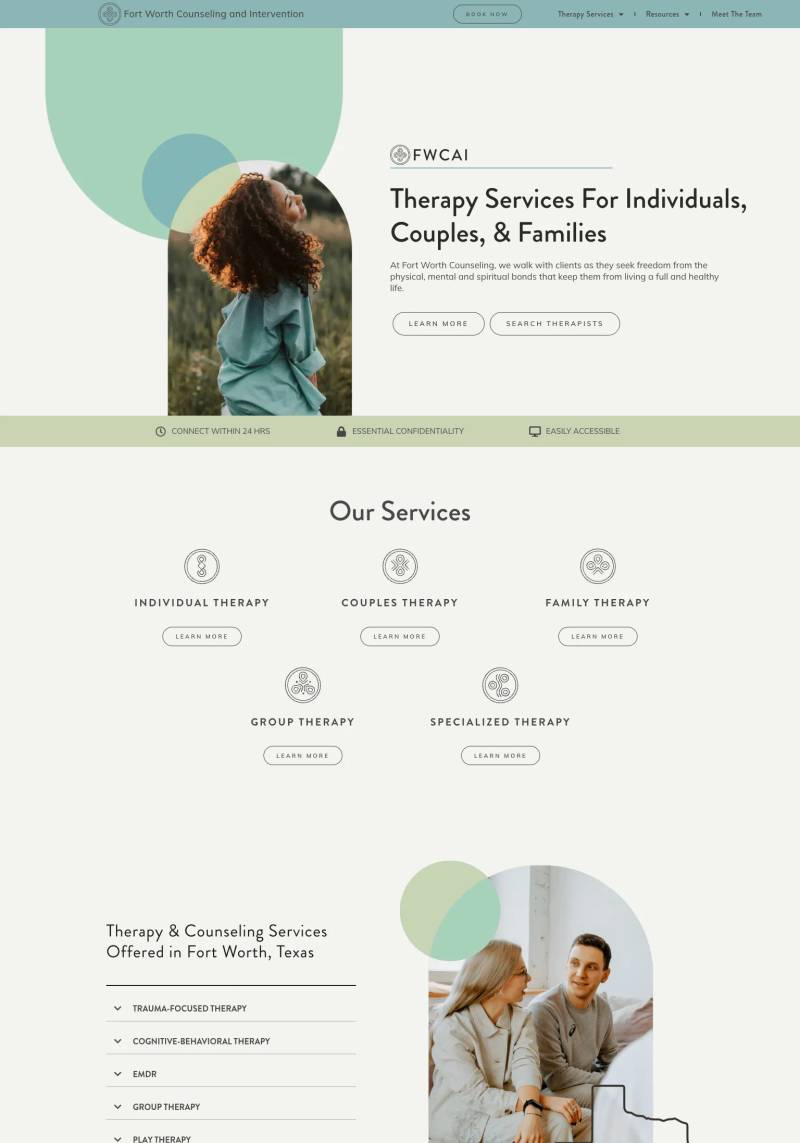
This therapy practice site frames emotional healing with "freedom from the physical, mental and spiritual bonds" and uses rounded photo cutouts with layered sage-green circles.
 Mimic this
This healthcare SaaS site uses neon green accent text and a black-hole visual to position remote patient monitoring as futuristic infrastructure.
 Mimic this
This family dentistry site structures its value in three icon cards—"Expert Dentists," "New Technology," "Accept Insurance"—below a hero with script-cursive accent on the word "smile."
 Mimic this
Teeth & Face
This dental practice site uses a circular badge reading "SMILE · LIVE · BREATHE" and pairs serif headings with colorful abstract face illustrations in the treatments section.
 Mimic this
Elemy
This pediatric autism care site uses serif headlines paired with circular image masks and soft blue-gray decorative arcs overlapping photo boundaries.
 Mimic this
This psychedelic retreat site uses an upside-down wildflower meadow hero image and serif headings stating "Attune to purpose and connection" over cream backgrounds.
 Mimic this
This chiropractic practice site uses a navy-and-gold color split with feature cards labeled "Every Patient Is Different" to emphasize personalized treatment plans.
 Mimic this
This chiropractic site leads with "Who Thought They Could Not Be Helped" in the hero headline, positioning itself as a specialist for difficult cases.
 Mimic this
This chiropractic practice site uses organic blob shapes in warm terracotta and sage to frame the hero image, replacing geometric layouts with natural forms.
 Mimic this
This chiropractic practice site leads with a "$47 New Patient Special" banner and repeats the offer across hero, cards, and CTAs to anchor pricing.
Design Data
The colors, fonts, and layout choices used across 80 WordPress medical websites.
Background color
How dark or light the page background is (background luminance).
- White / near white 67.5% (54)
- Mid-tone 8.8% (7)
- Dark 8.8% (7)
- Light 7.5% (6)
- Black / near black 7.5% (6)
Accent color
The color of each site's primary button, measured from its code (accent hue family).
- Black, white & gray 38.5% (30)
- Amber / orange 23.1% (18)
- Teal / cyan 9% (7)
- Green 9% (7)
- Blue 7.7% (6)
- Pink 3.8% (3)
- Purple 3.8% (3)
- Red 2.6% (2)
- Lime 2.6% (2)
Hero layout
How the top section arranges its headline and imagery.
- Text over a full-width image 50.7% (37)
- Text left, image right 34.2% (25)
- Centered text 5.5% (4)
- Image left, text right 5.5% (4)
- Text above full-width media 2.7% (2)
Hero imagery
The kind of visual the top section leads with.
- Photography 88.8% (71)
- No imagery 5% (4)
- Illustration 3.8% (3)
- Video 1.3% (1)
- 3D artwork 1.3% (1)
Button shape
Corner rounding on primary buttons (border radius relative to height).
- Pill (fully rounded) 45% (18)
- Square corners 30% (12)
- Rounded corners 25% (10)
Font combination
How heading and body typefaces pair (serif vs. sans-serif).
- All sans-serif 68.4% (26)
- Serif headings, sans-serif body 31.6% (12)
Color intensity
How colorful the palette is, from black-and-white to bold color (saturation).
- Soft, muted color 70% (56)
- Black & white 21.3% (17)
- Bold, vivid color 8.8% (7)
Dark mode support
Sites whose code adapts to the visitor's light/dark preference (prefers-color-scheme).
- Yes 6.3% (3)
- No 93.8% (45)
Most-used fonts
The typeface each site leads with, read from its live CSS.
- Poppins 15.8% (6)
- Montserrat 15.8% (6)
- Playfair Display 10.5% (4)
- Fraunces 5.3% (2)
- Raleway 5.3% (2)
Percentages are the share of sites where each trait could be measured, with counts in parentheses. Last updated August 2026.
Best WordPress medical website examples lean almost entirely on real photography
Of the 80 sites measured for hero media, 88.8% use a straight photograph as the hero image, compared with 64.1% across the whole gallery. That is a decisive departure from the norm, and it makes sense for a niche built on trust: a face, a treatment room, or a patient interaction reads as credible in a way illustration or 3D rendering cannot. Life Aligned Chiropractic , Scott County Chiropractic
 , Florida Orthopaedic Institute
 , and Dana McNeil
 all open with photography-led heroes, and the pattern holds across specialties, from WordPress Chiropractic Websites to WordPress Physical Therapy Websites. Anyone building in this space should treat commissioned photography as a line item, not an afterthought: illustration only accounts for 3.8% of heroes here, and stock-feeling abstraction is rare.
Stacked headline layouts have nearly vanished
Only 2.7% of measured heroes stack the copy above the image, against 17% gallery-wide, a near-total rejection of that structure. Medical sites overwhelmingly favor full-bleed overlay compositions (50.7%) or split layouts with copy on the left (34.2%), both of which let the photograph carry visual weight while text sits beside or over it rather than above it. Warsaw Chiropractic & Wellness Center and Kinetic Health
 both use this photograph-forward approach, keeping the headline compact and the image doing the persuasive work. If you are designing for WordPress Clinic Websites or WordPress Dental Websites, a stacked hero is the layout to avoid: it reads as a blog template, not a practice.
Muted color dominates over vibrant or monochrome
Muted palettes appear on 70% of sites here, versus 55% across the broader gallery, making this niche noticeably more subdued than typical. Only 8.8% go fully vibrant. South Bay Chiro , Health Wise Chiropractic
 , and Jaclyn Lim Psychology
 all pair muted tones with white backgrounds, reinforcing a calm, clinical register rather than an energetic one. This tracks with backgrounds themselves: 67.5% are near-white, and dark or near-black treatments together account for a small minority, seen in outliers like Dentist on Madison
 and Elevate Counseling
 . For WordPress Nutritionist Websites and WordPress Natural Health Websites, a muted, light-background palette signals wellness and cleanliness far more reliably than saturated brand colors.