192 Best Next.js Website Examples

Every site here is trying to prove credibility to a stranger in about three seconds. The best Next.js websites skip photography almost entirely. They lean on dark backgrounds and interface-led heroes instead, a pattern that held when I ran every site on this page through Claude. That trade-off buys speed and focus, but it means the design has to earn trust through layout and copy alone. Compare the Next.js SaaS sites and developer portfolios below to see how each side handles it.
Category
Platform
Style
 Mimic this
This productivity launcher site opens with "Your shortcut to everything" and demonstrates the command palette using a macOS desktop screenshot showing color-coded result items.
 Mimic this
This product management site positions Linear as "A new species of product tool" with a dark interface showing AI workflows alongside traditional issue tracking features.
 Mimic this
This AI search marketing site uses a node-based workflow builder mockup to visualize how agents optimize content for Claude search results.
 Mimic this
This screen recording SaaS site leads with a specific use case—"Team updates in the morning YouTube videos in the afternoon"—then showcases the product interface across three content-type tabs.
 Mimic this
This funeral services site opens with "We honour *every* detail" in italicized serif, positioning attention to particulars as its core promise.
 Mimic this
This private equity firm site uses serif italics for headlines and pairs aerial cornfield photography with "Investing our capital 'with a purpose'" to embed ESG messaging into the visual narrative.
 Mimic this
This cat sitting marketplace site uses organic blob shapes for imagery and scatters paw print icons throughout to emphasize "neighborhood cat community."
 Mimic this
This customer intelligence platform sells analysis speed with "Know your customers better than you know yourself, in 15 minutes" and a yellow card anchoring the product screenshot.
 Mimic this
This verifiable computing infrastructure site contrasts grayscale atmospheric hero imagery with a "guarantee what data is being used and generated" problem statement split across black and light gray text.
 Mimic this
This yoga studio site uses a serif-and-sans hierarchy with muted sage-green accents and rounded image containers to convey calm accessibility.
 Mimic this
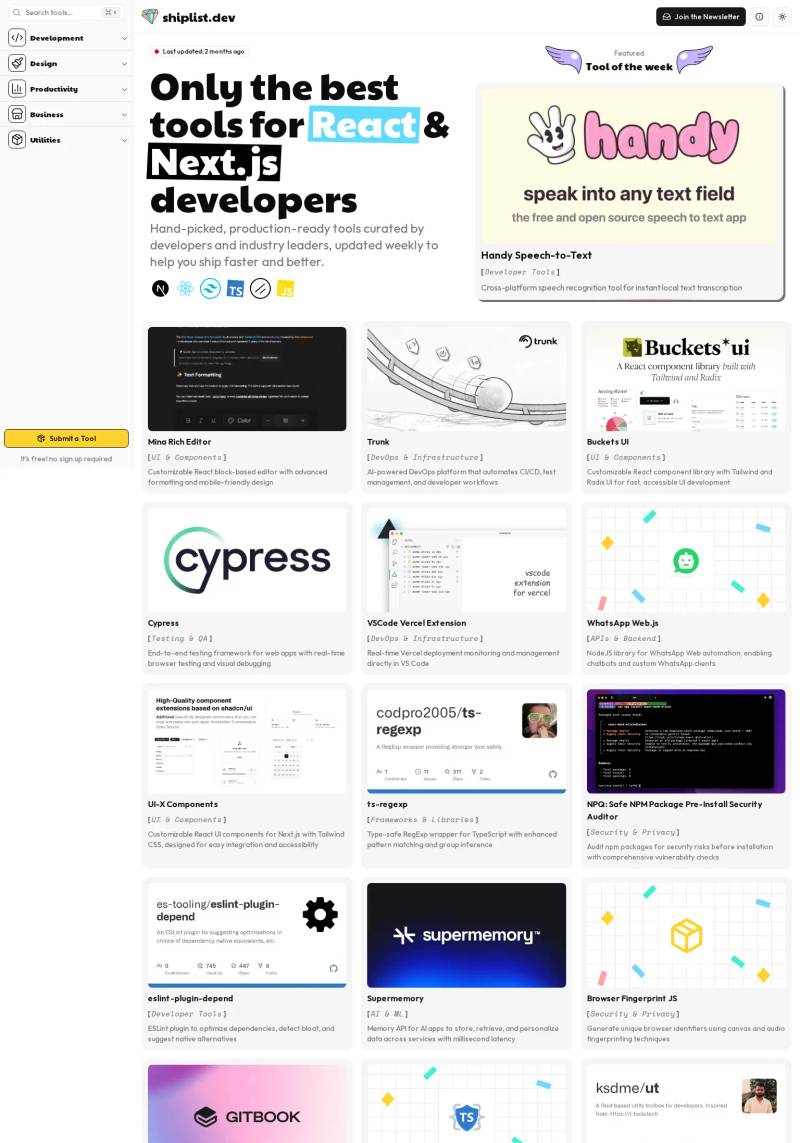
This developer tools directory highlights search terms in neon yellow and features a weekly "Tool of the Week" card above its three-column grid.
 Mimic this
This patent litigation AI platform uses a blueprint-style ampersand illustration and names its assistant "Andy" to humanize technical work product generation.
 Mimic this
This template marketplace site uses a promotional banner saying "Your template here" to double as both community message and advertising pitch.
 Mimic this
This voice data platform leads with "You are the source. Feul is your refinery"—positioning users as raw material suppliers to AI while a surreal ascending-figure hero image literalizes the ascent narrative.
 Mimic this
This boutique Pilates site uses mixed typography—serif italics highlighting key words like "your body" and "Elke"—paired with lavender-cream gradients and overlapping tilted photo cards.
 Mimic this
This boutique fitness site uses serif typography and gold accent buttons to position barre classes as editorial luxury rather than gym commodity.
 Mimic this
This Pilates studio site pairs dark olive photography with italic serif headlines and pill-shaped CTAs to signal luxury exclusivity.
 Mimic this
This fitness membership site leads with a hero image of the founder and italicizes "momentum" in the value prop: "A Strength x Pilates routine that builds *momentum* for life."
 Mimic this
This local electrician site uses a close-up tradesperson portrait with diagonal red geometric overlay and stacks trust signals as checkbox bullets in the hero.
 Mimic this
This real estate brokerage site leads with "Stop building *someone else's* empire" in mixed serif weights, positioning agent independence against traditional brokerages.
 Mimic this
This tax software site markets AI as a supernatural creature bound to Singapore's Income Tax Act, using redacted text blocks and yellow highlighter effects.
 Mimic this
This event attendance SaaS site opens with "Increase Your Event Attendance By 40%." and contrasts email's 18% open rate against SMS's 98% in a bar chart.
 Mimic this
This AI infrastructure site leads with a compliance guarantee—"Integrate any AI model you need, without sending data overseas"—then visualizes smart routing through a copper-colored branching diagram to model cards.
 Mimic this
This agritourism B2B site uses a hand-drawn serif display font layered over a green-tinted photo collage, with copy "Turn field trips into steady revenue in 30 days."
 Mimic this
This product ops SaaS site sells AI roadmap automation with "Your product intelligence is trapped in silos" as the friction point.
 Mimic this
This managed IT services site anchors its hero with "CLIENT OBSESSED CLOUD, CYBER AND AI" and "TECHNOLOGY PARTNER" in contrasting white and orange, backed by a warm radial gradient glow.
 Mimic this
This energy services site uses a 3D boiler render with floating annotated labels and hand-drawn arrows to visualize its core offering.
 Mimic this
This tutoring software site structures value through three pillar cards—Growth Engine, Operating System, AI Copilot—each detailing feature clusters rather than individual benefits.
 Mimic this
This automotive dealer platform leads with "Only 🔥 1 in 10 dealer sites passes our test"—using colored numerals and emoji to dramatize competitive underperformance.
Design Data
The colors, fonts, and layout choices used across 191 Next.js websites.
Background color
How dark or light the page background is (background luminance).
- White / near white 57.1% (109)
- Black / near black 30.4% (58)
- Dark 5.8% (11)
- Mid-tone 3.7% (7)
- Light 3.1% (6)
Accent color
The color of each site's primary button, measured from its code (accent hue family).
- Black, white & gray 27% (50)
- Amber / orange 20% (37)
- Blue 14.1% (26)
- Red 9.2% (17)
- Green 8.6% (16)
- Purple 8.6% (16)
- Teal / cyan 5.9% (11)
- Lime 3.2% (6)
- Pink 3.2% (6)
Hero layout
How the top section arranges its headline and imagery.
- Text left, image right 27.6% (40)
- Text above full-width media 23.4% (34)
- Text over a full-width image 21.4% (31)
- Centered text 20.7% (30)
- Image left, text right 4.8% (7)
Hero imagery
The kind of visual the top section leads with.
- Photography 36.8% (70)
- Product screenshot 22.6% (43)
- Illustration 20% (38)
- No imagery 13.2% (25)
- 3D artwork 5.8% (11)
Button shape
Corner rounding on primary buttons (border radius relative to height).
- Rounded corners 53.1% (34)
- Pill (fully rounded) 34.4% (22)
- Square corners 12.5% (8)
Font combination
How heading and body typefaces pair (serif vs. sans-serif).
- All sans-serif 82.7% (62)
- Serif headings, sans-serif body 13.3% (10)
- Monospace 2.7% (2)
- All serif 1.3% (1)
Color intensity
How colorful the palette is, from black-and-white to bold color (saturation).
- Soft, muted color 52.4% (100)
- Black & white 34.6% (66)
- Bold, vivid color 13.1% (25)
Dark mode support
Sites whose code adapts to the visitor's light/dark preference (prefers-color-scheme).
- Yes 15.2% (12)
- No 84.8% (67)
Most-used fonts
The typeface each site leads with, read from its live CSS.
- Inter 9.3% (7)
- Poppins 5.3% (4)
- GeistSans 5.3% (4)
- DM Sans 2.7% (2)
- Graphik 2.7% (2)
Percentages are the share of sites where each trait could be measured, with counts in parentheses. Last updated August 2026.
Best Next.js website examples skip the photo hero
Photography leads hero media on only 36.8% of Next.js sites, against 64.1% across the whole gallery, a gap wide enough to call this platform’s defining trait. Where photo-led design dominates elsewhere, Next.js builds favor product mockups (22.6%) and illustration (20%) instead, treating the hero as a demonstration surface rather than a mood board. Cal and ScrubSync put a product screenshot front and center, while CrowdSec leans on illustration to explain a technical product without a single photograph. This matters for anyone building in the Next.js SaaS Websites category: the platform’s technical audience expects to see the interface, not a lifestyle shot.
Near-black backgrounds are nearly a third of the gallery
Near-black backgrounds appear on 30.4% of Next.js sites, compared with 18.1% gallery-wide, making this the platform’s second clearest signature. That is still well behind near-white, which holds 57.1%, but the near-black share is large enough that dark-mode-first design reads as a deliberate convention rather than a fringe choice. Vercel , Raycast
 , and Next.js itself all run near-black backgrounds paired with black-and-white palettes, and Aashni Shah shows the same approach carrying through to a photography-led portfolio. Anyone shipping a developer tool on this platform should treat near-black as a live, credible option rather than a departure from the norm.
Full-bleed overlay heroes are underused here
Only 21.4% of Next.js sites use a full-bleed overlay hero, against 35.7% across the gallery, continuing the pattern set by the photo numbers: overlay heroes need a strong photographic background, and Next.js sites are not building around photography. Split-copy-left (27.6%) and stacked-copy-top (23.4%) arrangements lead instead, arrangements suited to placing a mockup or illustration beside or beneath a headline. Arc for Students and Buffer both structure their heroes around a product screenshot rather than an image bleeding to the edges of the viewport.
Buttons stay rounded, rarely square
Rounded corners take 53.1% of CTA shapes, pill shapes take 34.4%, and square sits at just 12.5%, with a median corner radius of 9px. This is a low-commitment default: rounded buttons read as safe and modern without demanding a design decision. Huly and CrowdSec both use rounded buttons against muted palettes, a combination common enough among developer-tool sites and portfolio builds alike, including many featured in the Next.js Web Developer Portfolio Websites collection.