39 Best Coffee Shop Website Examples

Before anything else, you have to decide whether your coffee shop site feels warm or clean. I ran every one of the best coffee shop websites here through Claude. Light backgrounds dominate this set far more than across the rest of the gallery. But light does not mean sterile. The sites that work pair that brightness with warm photography and rich accent tones. Compare the examples below and notice how the flat ones use a light background with nothing warm to anchor it.
Category
Platform
Style
 Mimic this
This boba catering site emphasizes customization with golden highlights on "customizability" and "at your event" paired with carousel photo overlaps.
 Mimic this
This community hub site arranges scattered, rotated photos in a radial collage around a central orange badge, anchoring the dark green hero.
 Mimic this
This specialty coffee shop site uses small peach decorative lines above each section heading and warm-toned photography to emphasize its home-kitchen operation.
 Mimic this
This coffee shop site leads with "Brewed to perfection" in serif, then pairs dual CTAs (Order Now / Explore menu) with a staggered carousel of drink and food photos.
 Mimic this
This portable coffee equipment site leads with "POUR-OVER ON THE GO" over a golden-hour outdoors photo and uses a scrolling banner listing environmental benefits.
 Mimic this
This specialty coffee site uses a scrolling chartreuse announcement bar and superscript numbers in category labels to signal rare drops.
 Mimic this
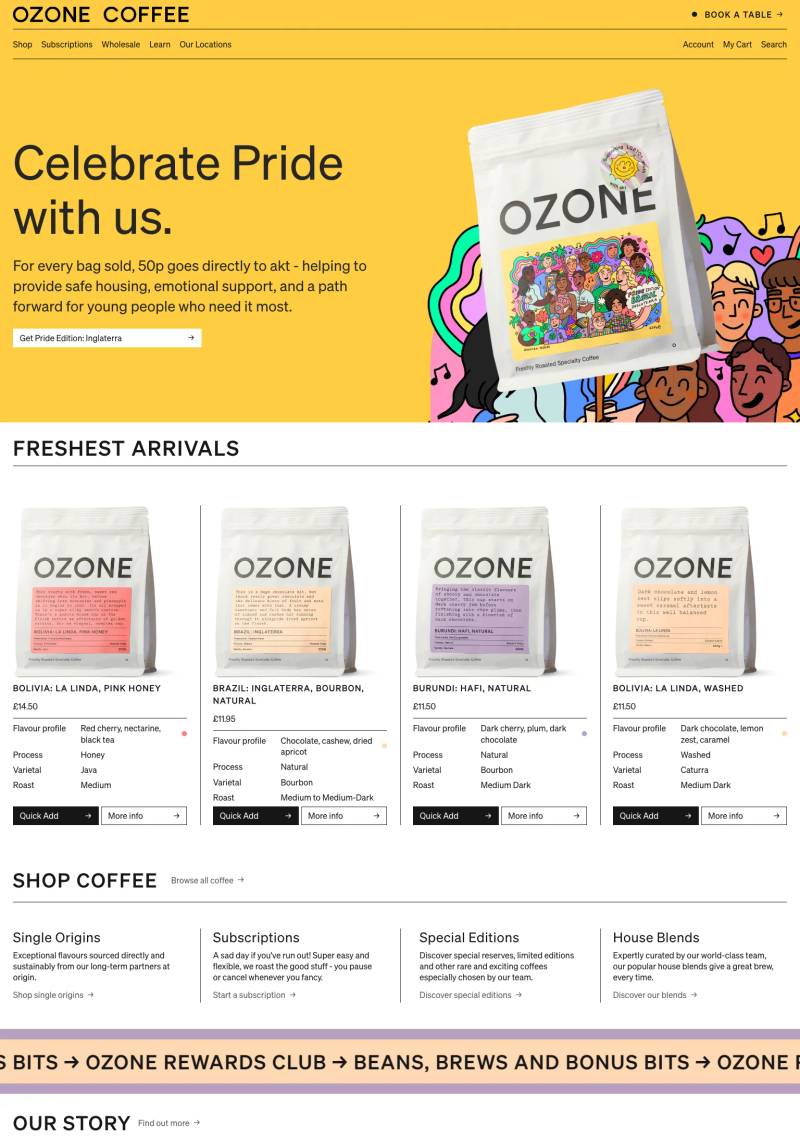
This specialty coffee retailer pairs a golden-yellow Pride campaign hero with a four-column product grid showing flavor profiles, process, and roast attributes in micro-typography tables.
 Mimic this
This specialty coffee site uses alternating sage-green and cream sections with oversized semi-transparent "GoodNews" marquee text and smiley-face icons as brand anchors.
 Mimic this
This mobile coffee site uses a massive red serif "Starlight" headline paired with a two-column events layout and full-bleed photo grid of the red trailer.
 Mimic this
CTRL COFFEE
This coffee shop site stacks full-width sections in bright yellow and red, each pairing a chunky condensed heading with a rotated product photo and pink starburst CTA badge.
 Mimic this
This specialty coffee e-commerce site uses gradient-tinted product cards—Ethiopian warm brown, Blue Moon teal, Brazilian charcoal—each with centered imagery and centered "Shop Now" buttons.
 Mimic this
This coffee franchise site sells expansion with a highlighted phrase—"THE SMARTEST COFFEE" sits in a lime green pill—and a world map color-coded by regional targets.
 Mimic this
This coffee franchise site uses tilted product cards, a coffee-bean logo mark, and "Become one of us!" as the franchise pitch.
 Mimic this
This specialty coffee brand site embeds its sustainability message in the hero's flat-lay photography, pairing scattered beans and botanical leaves with the mission "Everything starts from the GROUND."
 Mimic this
This specialty coffee e-commerce site leads with a maximalist isometric hero of scattered beans, Catch packaging, and unrelated objects—fire hydrant, bicycle, smiley emoji—before listing filter and espresso blends.
 Mimic this
This specialty coffee roaster merges product grids with restaurant imagery, layering massive compressed typography and yellow highlight bars over food photography.
 Mimic this
This coffee shop site uses a fixed transparent header over a barista pour hero, with product cards in alternating dark-green and cream backgrounds.
 Mimic this
This premium coffee e-commerce site positions beans as treasure with a glowing chest and continuous "Shop Now" marquee scrolling across white space.
 Mimic this
This specialty coffee shop uses italic serif display fonts paired with a burnt-orange service bar listing "COFFEE BAR - RETAIL COFFEE - BARISTA TRAINING - MACHINE SERVICING."
 Mimic this
This Russian coffee chain site uses city-selector pill buttons and dual CTA buttons ("Позвонить" / Telegram) to route orders by location.
 Mimic this
This specialty coffee shop leads with "Care for Coffee. Drink Alrighty" and uses a scrolling ticker promoting "100% Underdog Farmers" and climate-compensated sourcing.
 Mimic this
This specialty coffee site uses macro product photography in a triptych layout and announces savings with "Subscribe & save 10% off your favorite products."
 Mimic this
This gluten-free coffee shop site pairs dark navy backgrounds with gold accents and uses wheat-stalk illustrations integrated into the logo mark.
 Mimic this
This specialty coffee shop uses uppercase monospaced typography with hand-drawn stamp logos and "DAMN FINE COFFEE™" as its sole product narrative.
 Mimic this
This specialty coffee site uses a three-column feature layout pairing product imagery with "Exquisite," "Fresh," and "Ethical" copy to justify premium pricing.
 Mimic this
This student café site uses a scrolling marquee banner to announce seasonal closures above a hero photograph of students gathered around a table.
 Mimic this
This specialty coffee site leads with a Chemex pour-over photograph and defines its product via Filipino etymology—"kâ pé | n. Filipino, 'coffee'"—before mentioning Indigenous grower partnerships.
 Mimic this
This specialty coffee site stages each product bag in narrative lifestyle scenes—beach, moonlit pedestal, desert rocks—rather than flat product shots.
 Mimic this
This specialty coffee shop uses a scrolling marquee banner, neon color blocks between sections, and handwritten fonts to position coffee as approachable rather than pretentious.
 Mimic this
This specialty coffee site replaces a hero headline with large serif category words—"COFFEE TEA PASTRIES"—layered over a vintage espresso machine and ornate gold security gate.
Design Data
The colors, fonts, and layout choices used across 39 coffee shop websites.
Background color
How dark or light the page background is (background luminance).
- White / near white 41% (16)
- Light 25.6% (10)
- Mid-tone 15.4% (6)
- Black / near black 10.3% (4)
- Dark 7.7% (3)
Accent color
The color of each site's primary button, measured from its code (accent hue family).
- Amber / orange 47.4% (18)
- Black, white & gray 26.3% (10)
- Red 15.8% (6)
- Lime 5.3% (2)
- Pink 2.6% (1)
- Teal / cyan 2.6% (1)
Hero layout
How the top section arranges its headline and imagery.
- Text over a full-width image 43.3% (13)
- Text left, image right 16.7% (5)
- Text above full-width media 13.3% (4)
- Asymmetric 13.3% (4)
- Centered text 6.7% (2)
Hero imagery
The kind of visual the top section leads with.
- Photography 76.9% (30)
- Product screenshot 15.4% (6)
- Illustration 7.7% (3)
Color intensity
How colorful the palette is, from black-and-white to bold color (saturation).
- Soft, muted color 66.7% (26)
- Bold, vivid color 30.8% (12)
- Black & white 2.6% (1)
Percentages are the share of sites where each trait could be measured, with counts in parentheses. Last updated August 2026.
Best coffee shop website examples almost never go monochrome
Only 2.6% of the coffee shop sites here land in the monochrome saturation bucket, against 29.7% across the wider gallery, a gap of more than tenfold. Coffee branding leans on the visual warmth of the product itself: the tone of a roast, the steam off a cup, the grain of wood counters. Stripping color out removes exactly what makes coffee photography persuasive. Instead, 66.7% of these sites sit in the muted range, keeping photos and palettes calm rather than desaturating them entirely. Damn Fine Coffee Bar , Against the Grain
 , and Anthem Stories
 all show this restraint: near-black backgrounds paired with muted, not colorless, imagery. Cofix
 is the rare outlier running an actual black-and-white palette, and it reads as a deliberate exception rather than a template choice.
Amber is the default accent, not just a favorite
Amber shows up as the accent hue on 47.4% of these sites, nearly double the 23.7% rate across the full gallery. This is the most on-brand finding on the page: amber mirrors espresso, caramel, and roasted bean tones directly, so it functions as an accent that reinforces subject matter rather than fighting it. Bliss Coffee Roasters uses amber buttons against a light background, and Catch
 pairs amber accents with a dark, moody base, proving the hue works across very different luminance settings. Neutral accents come second at 26.3%, but amber’s lead is wide enough that any coffee shop site skipping it is choosing to stand apart from most of the field.
Light backgrounds carve out real territory beyond plain white
Light backgrounds (not full white, but a step down) account for 25.6% of this gallery, more than double the 11.3% rate seen across the wider set. White itself still leads through the near_white bucket at 41%, so white-dominant design remains the baseline, as seen in Cortadito Coffee House , 803 Outpost Coffee
 , and Starlight Coffee
 . But the elevated light-background share shows a meaningful subset choosing warm off-white tones instead, visible in Bliss Coffee Roasters, Ngofee
 , and Ozone Coffee
 . For a coffee shop website design, that softer light tone can suggest paper, cream, or milk foam without the starkness of pure white, giving photography a gentler frame to sit in.