15 Best Shopify Coffee Shop Website Examples

I found the best Shopify coffee shop websites that brew up profits!
These sites prove that personality sells more beans than polish ever will. Here’s what actually works:
- Lead with a scrolling marquee. Couplet Coffee
 and East Feller
 use continuous ticker banners to create urgency… and it works because Shopify’s section architecture makes these dead simple to implement.
 - Commit to one bold color. Blava
 goes full monochromatic blue across everything. GAMA uses lime-green. On Shopify’s rigid templates, a strong palette does the heavy lifting.
 - Name products like cravings. GAMA calls blends “Brownie” and “Apple Pie,” instantly bypassing coffee snobbery.
Browse these Shopify coffee shop design examples below for more inspiration.
Category
Platform
Style
 Mimic this
This portable coffee equipment site leads with "POUR-OVER ON THE GO" over a golden-hour outdoors photo and uses a scrolling banner listing environmental benefits.
 Mimic this
This specialty coffee site uses a scrolling chartreuse announcement bar and superscript numbers in category labels to signal rare drops.
 Mimic this
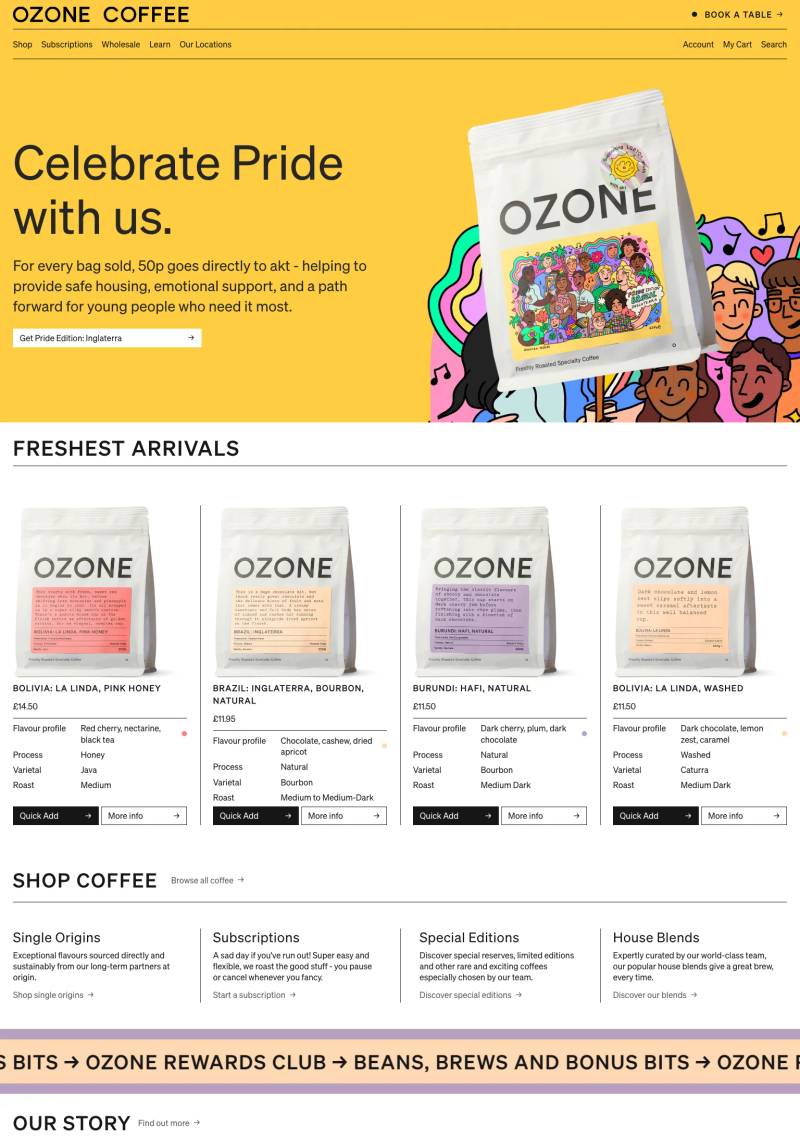
This specialty coffee retailer pairs a golden-yellow Pride campaign hero with a four-column product grid showing flavor profiles, process, and roast attributes in micro-typography tables.
 Mimic this
This specialty coffee site uses alternating sage-green and cream sections with oversized semi-transparent "GoodNews" marquee text and smiley-face icons as brand anchors.
 Mimic this
This specialty coffee e-commerce site leads with a maximalist isometric hero of scattered beans, Catch packaging, and unrelated objects—fire hydrant, bicycle, smiley emoji—before listing filter and espresso blends.
 Mimic this
This specialty coffee roaster merges product grids with restaurant imagery, layering massive compressed typography and yellow highlight bars over food photography.
 Mimic this
This premium coffee e-commerce site positions beans as treasure with a glowing chest and continuous "Shop Now" marquee scrolling across white space.
 Mimic this
This specialty coffee shop uses italic serif display fonts paired with a burnt-orange service bar listing "COFFEE BAR - RETAIL COFFEE - BARISTA TRAINING - MACHINE SERVICING."
 Mimic this
This specialty coffee shop leads with "Care for Coffee. Drink Alrighty" and uses a scrolling ticker promoting "100% Underdog Farmers" and climate-compensated sourcing.
 Mimic this
This specialty coffee site uses macro product photography in a triptych layout and announces savings with "Subscribe & save 10% off your favorite products."
 Mimic this
This specialty coffee shop uses uppercase monospaced typography with hand-drawn stamp logos and "DAMN FINE COFFEE™" as its sole product narrative.
 Mimic this
This specialty coffee site uses a three-column feature layout pairing product imagery with "Exquisite," "Fresh," and "Ethical" copy to justify premium pricing.
 Mimic this
This specialty coffee shop uses a scrolling marquee banner, neon color blocks between sections, and handwritten fonts to position coffee as approachable rather than pretentious.
 Mimic this
This specialty coffee shop uses a monochromatic blue-and-white palette across product photography, packaging, and lifestyle imagery for complete brand cohesion.
 Mimic this
This specialty coffee shop uses a lime-green banner announcement and color-blocked product grids with flavor-inspired names like "Brownie" and "Apple Pie."