194 Best Community Website Examples

How do you make a community feel alive before someone has even joined it? The best community websites lead with real photography of real people. That pattern shows up here far more often than in any other category I ran through Claude. Most skip dark backgrounds entirely, leaning on warm, light palettes that feel open. Compare the Church and Nonprofit examples below against the generic stock-image hero you were probably planning to use.
Category
Platform
Style
 Mimic this
This funeral services site embeds decorative leaf and butterfly icons within serif headlines to soften "Plan a meaningful goodbye that feels right — for you, your family, and the planet."
 Mimic this
This funeral home site layers casket and floral photographs in an overlapping collage, anchoring "Compassionate Care When You Need It Most" with golden accents.
 Mimic this
This funeral services site pairs serif headlines about "authenticity and care" with soft sage backgrounds, mint circles, and photos of lisianthus flowers on coffins.
 Mimic this
This funeral home site anchors trust with a gold shield crest, serif typography, and the tagline "Professional Services With Personal Care" since 1954.
 Mimic this
This funeral services site opens with "We honour *every* detail" in italicized serif, positioning attention to particulars as its core promise.
 Mimic this
This funeral services site organizes navigation around a fixed "Call Us" button and pairs moody chapel photography with serif fonts and olive-green accents throughout.
 Mimic this
This Jewish funeral services site pairs aerial neighborhood photography with serif italics and an orange accent block to convey "respectful, Jewish burials while supporting families through their time of need."
 Mimic this
This funeral planning site leads with "The UK's Lowest Priced Direct Cremation Funeral Plan £1,395" as a gold label above the headline, using warm cream backgrounds and rounded photo masks to humanize cost-focused services.
 Mimic this
This youth mental health nonprofit uses handwritten display typography, organic blob photo containers, and scattered doodle stars to make mental health approachable.
 Mimic this
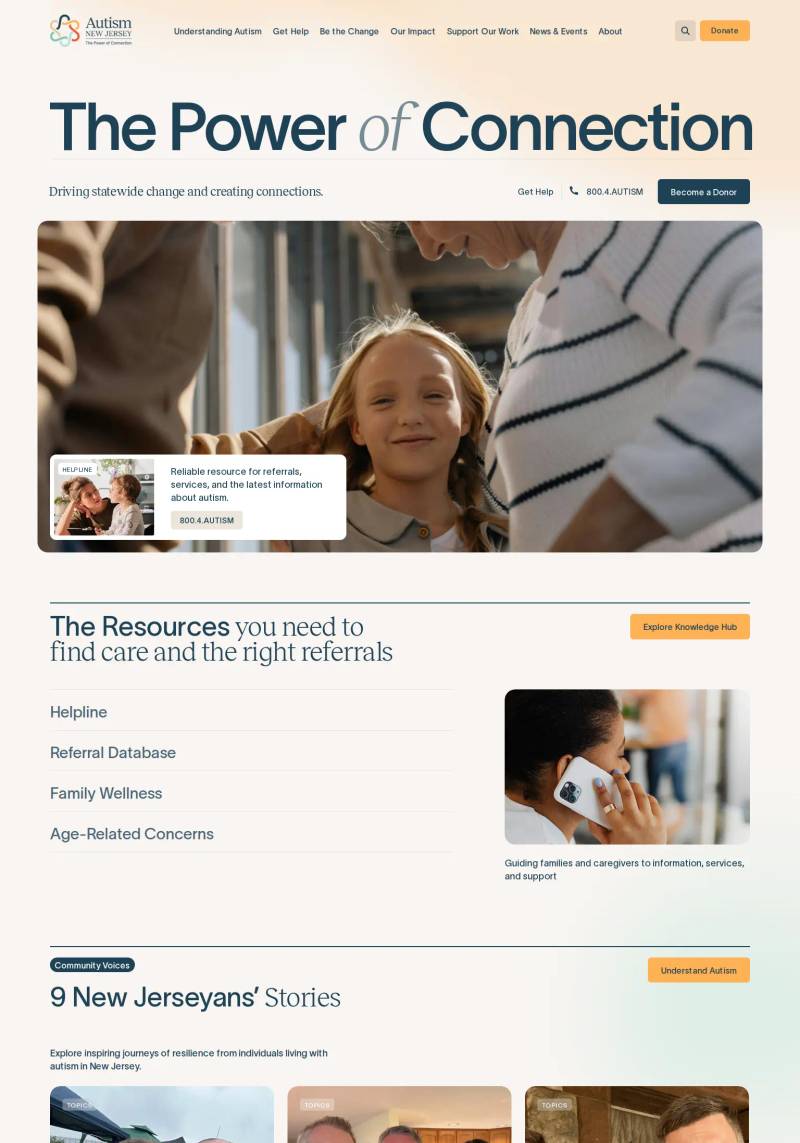
This nonprofit resource site emphasizes connection through mixed-weight serif typography: "The Power *of* Connection" italicizes the preposition.
 Mimic this
This non-profit educational books site pairs oversized serif typography and dark backgrounds with vibrant children's book imagery to convey premium brand positioning.
 Mimic this
This non-profit blood bike charity site leads with a motion-blurred motorcycle hero and anchors messaging around "Every blood run can save a life."
 Mimic this
This nonprofit site sells disc golf's global mission with "YOU CAN SHARE DISC GOLF WITH THE WORLD" over photos of African communities playing the sport.
 Mimic this
This youth basketball organization site uses mixed-weight serif typography in the hero—bold and italic contrasts in "BUILDING BETTER PEOPLE THROUGH BASKETBALL"—paired with black-and-white team photography.
 Mimic this
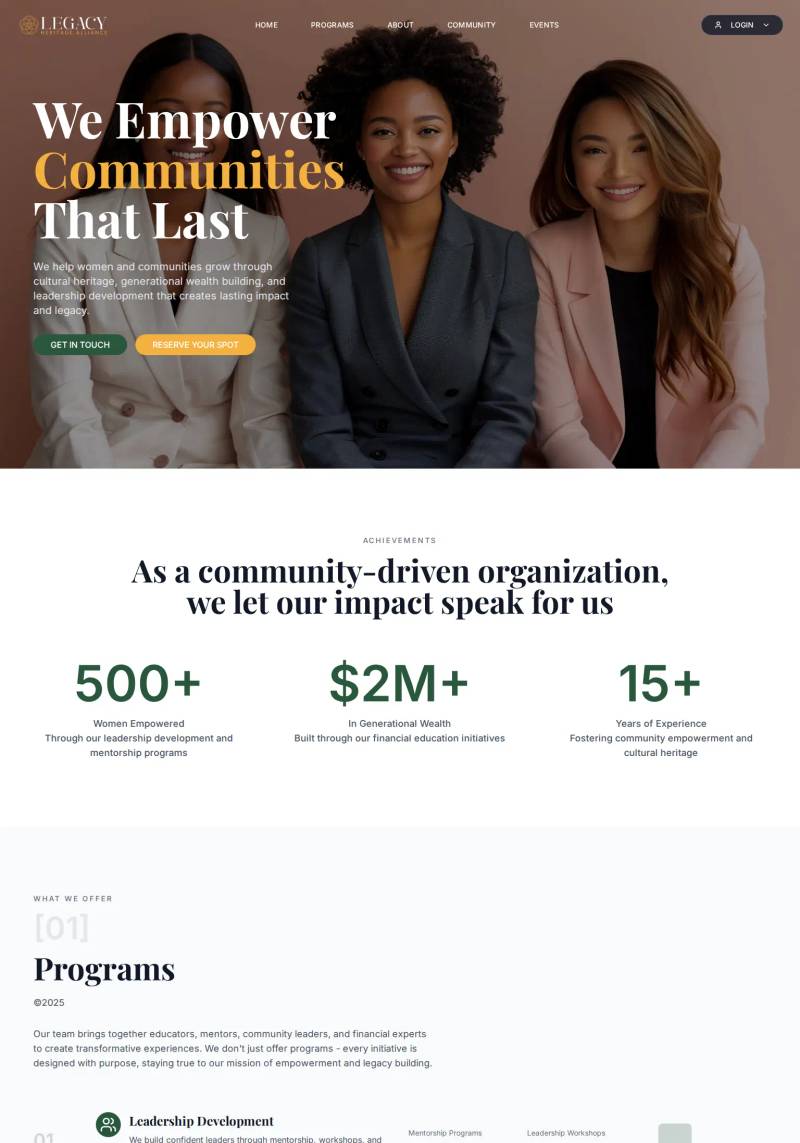
This women's empowerment nonprofit site uses serif headings with one word italicized in accent color and hero photography of diverse professionals against warm gradients.
 Mimic this
This nonprofit site opens with an italicized serif headline "Together, we nurture hope in the Philippines" paired with a collage of rotated child portraits and gold star accents.
 Mimic this
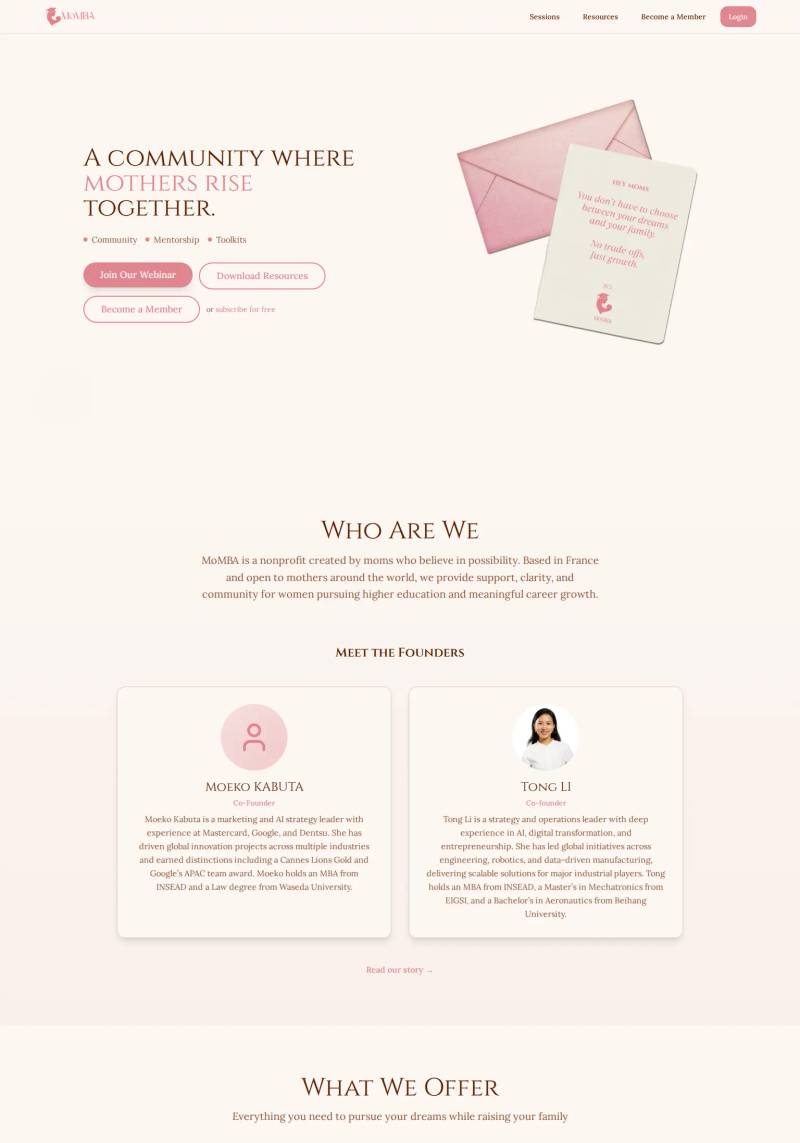
This nonprofit community site uses diamond-rotated avatar frames and mixed italic/brown serif typography to position mother's career support as elegant rather than utilitarian.
 Mimic this
This church site uses a purple accent pill ("You Belong Here! →") and repeating scrolling ticker to reinforce its movement-focused mission statement.
 Mimic this
This impact investing platform uses serif italics and pastel gradient blobs to position women founders and investors as both mission-driven and financially smart.
 Mimic this
This Web3 fashion marketplace uses full-bleed mosaic grids of editorial photography with the headline "THE FASHION ECOSYSTEM IS REBORN."
 Mimic this
This nonprofit coffee site uses a burnt orange accent color throughout and centers a hero image of a woman farmer with the headline "Powering Women Coffee Producers to Build Thriving Livelihoods."
 Mimic this
This nonprofit site centers survivor leadership with a three-column value prop, then pivots to stark statistics using a split layout: dusty rose callout ("Human trafficking happens here?? YES.") against dark charcoal impact numbers.
 Mimic this
This church site emphasizes community through two-column layouts pairing group photos with action buttons for "Join on a Sunday" and "Find a GrowthGroup."
 Mimic this
This church site announces a rebrand with "SAME CHURCH, NEW NAME." in heavy italic display type over a candid lobby photo and royal blue banner.
 Mimic this
This church site uses an orange announcement banner and italic serif headline ("Share The Love Of Jesus") to balance urgency with invitation.
 Mimic this
This faith-tech landing page targets "inconsistent, distracted, busy Christians" with a streak-tracking app positioned through SaaS design conventions and purple accent colors.
 Mimic this
Rally Austin
This economic development nonprofit uses an inverted highlight treatment on "PURPOSE" and a scrolling marquee of initiative names separated by purple diamond bullets.
 Mimic this
This funeral services site uses angled card tops and circular bordered portraits to break up a dark gold-and-charcoal layout selling "A caring funeral director in Northampton."
 Mimic this
This funeral home site uses illustrated building portraits and circular photo galleries to humanize end-of-life services alongside "Make preferred location" heart-icon buttons.
 Mimic this
This church leadership network site uses italic serif accents on key words—"*Church*," "*leaders*," "*healthy churches*"—to interrupt uppercase sans-serif headlines and copy.
Design Data
The colors, fonts, and layout choices used across 246 community websites.
Background color
How dark or light the page background is (background luminance).
- White / near white 62.6% (154)
- Mid-tone 15.4% (38)
- Light 9.3% (23)
- Dark 8.1% (20)
- Black / near black 4.5% (11)
Accent color
The color of each site's primary button, measured from its code (accent hue family).
- Amber / orange 28.7% (66)
- Black, white & gray 21.3% (49)
- Red 13.9% (32)
- Teal / cyan 13.5% (31)
- Blue 6.5% (15)
- Green 6.1% (14)
- Pink 3.5% (8)
- Lime 3.5% (8)
- Purple 3% (7)
Hero layout
How the top section arranges its headline and imagery.
- Text over a full-width image 56% (84)
- Text left, image right 19.3% (29)
- Text above full-width media 16% (24)
- Centered text 5.3% (8)
- Asymmetric 2.7% (4)
Hero imagery
The kind of visual the top section leads with.
- Photography 85.4% (210)
- Illustration 6.9% (17)
- No imagery 4.5% (11)
- Product screenshot 1.6% (4)
- Video 1.2% (3)
Button shape
Corner rounding on primary buttons (border radius relative to height).
- Pill (fully rounded) 50% (33)
- Rounded corners 28.8% (19)
- Square corners 21.2% (14)
Font combination
How heading and body typefaces pair (serif vs. sans-serif).
- All sans-serif 65.3% (47)
- Serif headings, sans-serif body 31.9% (23)
- All serif 2.8% (2)
Color intensity
How colorful the palette is, from black-and-white to bold color (saturation).
- Soft, muted color 62.6% (154)
- Black & white 19.9% (49)
- Bold, vivid color 17.5% (43)
Dark mode support
Sites whose code adapts to the visitor's light/dark preference (prefers-color-scheme).
- Yes 6.1% (5)
- No 93.9% (77)
Most-used fonts
The typeface each site leads with, read from its live CSS.
- Poppins 6.9% (5)
- futura-pt 4.2% (3)
- proxima-nova 4.2% (3)
- Frank Ruhl Libre 2.8% (2)
- Libre Baskerville 2.8% (2)
Percentages are the share of sites where each trait could be measured, with counts in parentheses. Last updated August 2026.
Best community website examples lean on real photography, not illustration
Photography dominates the hero space here: 85.4% of sites use a photo-led hero, well above the 64.1% rate across the wider gallery. Community organizations are selling trust in real people and real places, so a stock illustration or abstract graphic reads as distant. Minhaj Interfaith and Welfare Foundation , All Breed Animal Rescue of the Carolinas
 , and Equal Access Education
 all open with photography, and that pattern holds whether the group is a mosque, an animal shelter, or an education nonprofit. Anyone building in this niche should treat a photo shoot as a launch requirement, not a nice-to-have. This same instinct carries into adjacent categories: browse the Church Websites and Nonprofit Websites galleries and the photo-first hero remains the default.
Near-black backgrounds barely survive contact with this niche
Only 4.5% of sites here sit on a near-black background, compared with 18.1% across the full gallery. Community-facing organizations are asking for donations, volunteers, and trust from strangers, and a dark, moody canvas works against that warmth. The near-black look survives only in outliers like Sky’s the Limit, which pairs its dark background with a stark black-and-white palette and a product-screenshot hero, a combination that reads more like a software landing page than a community one. The overwhelming majority sit instead in near-white territory (62.6%), the register favored by Givebutter , Charitable
 , and My Choice Adoptions
 .
.
Teal punches above its weight as an accent choice
Teal shows up as the accent hue on 13.5% of sites here, roughly double its 6.7% share gallery-wide, putting it just behind red and ahead of blue and green. Abhiprerna Foundation uses teal buttons against a white background with display headings, proving the hue can carry warmth without leaning on the amber or red that dominate elsewhere in the set. Amber still leads overall at 28.7%, seen in the square buttons of Abington Funeral Services
 and EastWest Food Rescue
 , but teal’s outsized presence here marks it as a genuine alternative rather than a rounding error. Organizations wary of amber’s charity-cliché feel, including those browsing Funeral Home Websites for a calmer register, have a proven second option.
Pill buttons are the default shape, not just a preference
Half of the sites measured for CTA shape use pills, more than either rounded or square options combined against each. Art of Living , MAF
, MAF , and My Choice Adoptions all pair pill buttons with photography-led heroes and muted palettes, reinforcing a soft, approachable interface that matches the photo-first sensibility already established. Square buttons persist mainly among sites already committed to a bolder, more institutional voice, as with Abington Funeral Services and Congo Leaders Initiative (CLI)
 .
.