113 Best Nonprofit Website Examples

Nonprofit sites have to do something most other categories don’t: convince a stranger to hand over money on trust alone. So you’d expect the best nonprofit websites to play it safe with neutral backgrounds and muted palettes. But colour, as Claude’s classification of every site here confirmed, is almost universal across these designs. Most skip plain black-and-white entirely and lean into warm, mission-driven palettes alongside bold hero photography. Compare the examples below and notice where each one puts its accent colour relative to the donate button.
Category
Platform
Style
 Mimic this
This youth mental health nonprofit uses handwritten display typography, organic blob photo containers, and scattered doodle stars to make mental health approachable.
 Mimic this
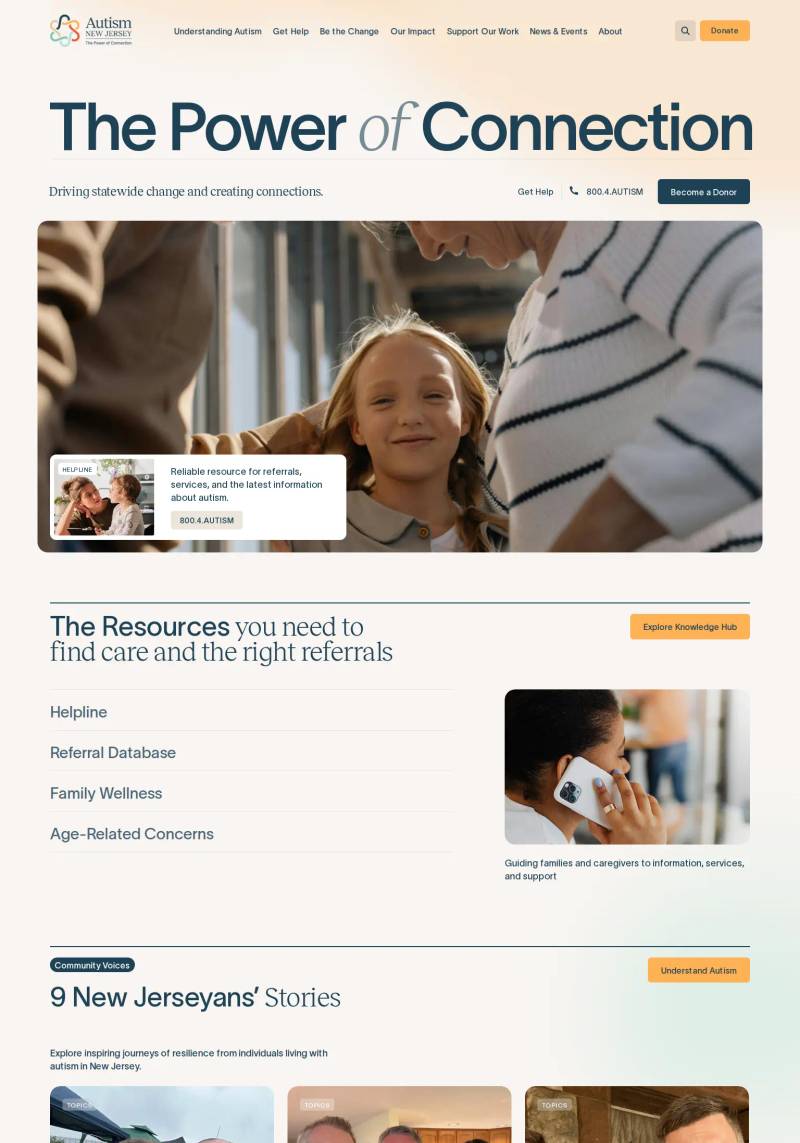
This nonprofit resource site emphasizes connection through mixed-weight serif typography: "The Power *of* Connection" italicizes the preposition.
 Mimic this
This non-profit educational books site pairs oversized serif typography and dark backgrounds with vibrant children's book imagery to convey premium brand positioning.
 Mimic this
This non-profit blood bike charity site leads with a motion-blurred motorcycle hero and anchors messaging around "Every blood run can save a life."
 Mimic this
This nonprofit site sells disc golf's global mission with "YOU CAN SHARE DISC GOLF WITH THE WORLD" over photos of African communities playing the sport.
 Mimic this
This youth basketball organization site uses mixed-weight serif typography in the hero—bold and italic contrasts in "BUILDING BETTER PEOPLE THROUGH BASKETBALL"—paired with black-and-white team photography.
 Mimic this
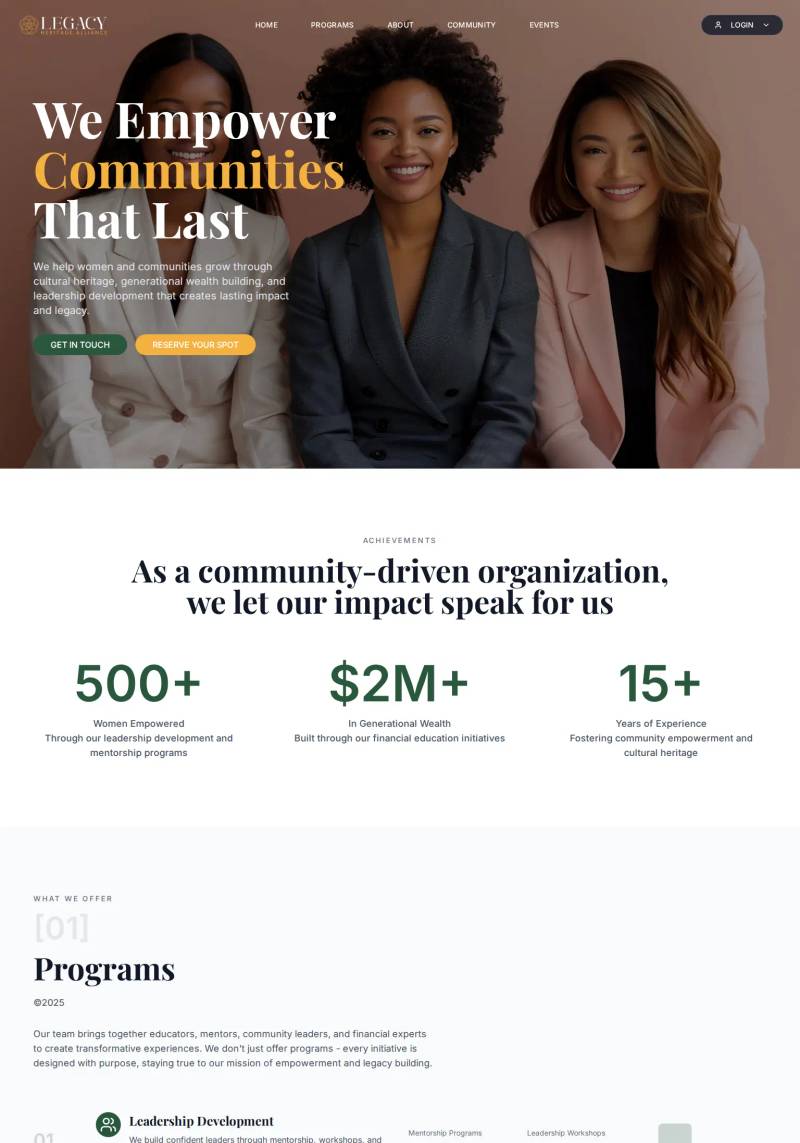
This women's empowerment nonprofit site uses serif headings with one word italicized in accent color and hero photography of diverse professionals against warm gradients.
 Mimic this
This nonprofit site opens with an italicized serif headline "Together, we nurture hope in the Philippines" paired with a collage of rotated child portraits and gold star accents.
 Mimic this
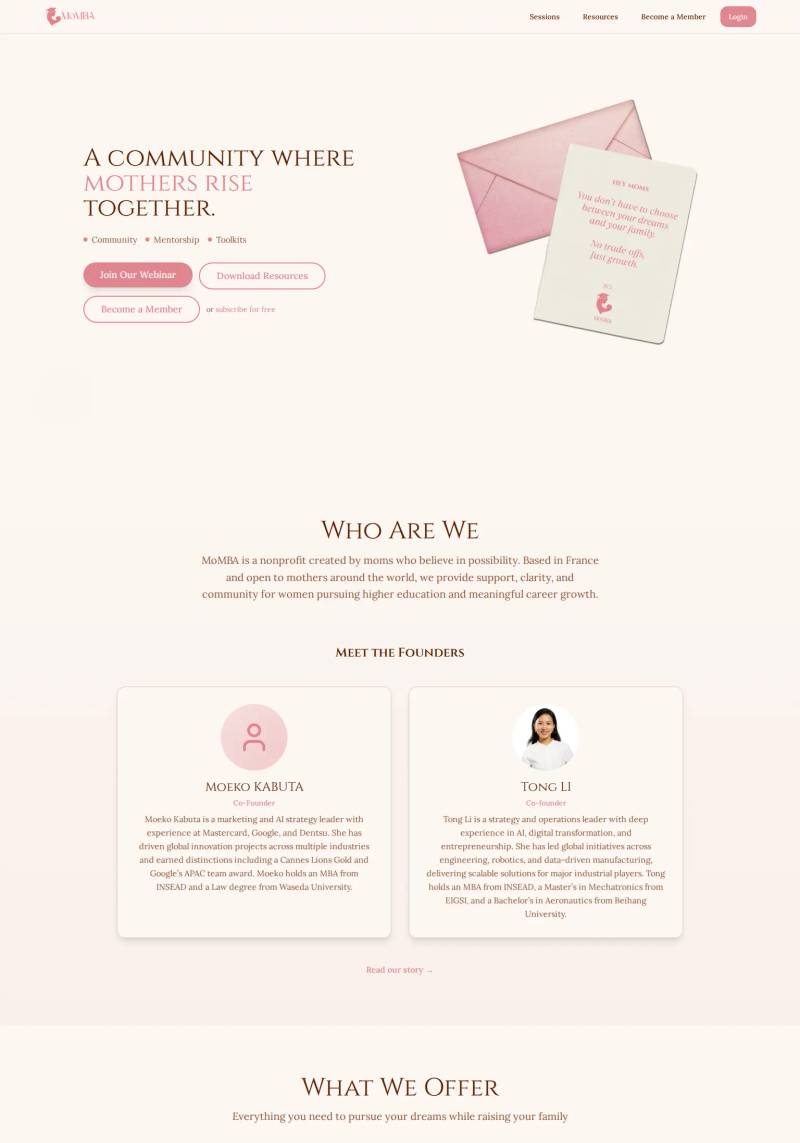
This nonprofit community site uses diamond-rotated avatar frames and mixed italic/brown serif typography to position mother's career support as elegant rather than utilitarian.
 Mimic this
This impact investing platform uses serif italics and pastel gradient blobs to position women founders and investors as both mission-driven and financially smart.
 Mimic this
This nonprofit coffee site uses a burnt orange accent color throughout and centers a hero image of a woman farmer with the headline "Powering Women Coffee Producers to Build Thriving Livelihoods."
 Mimic this
This nonprofit site centers survivor leadership with a three-column value prop, then pivots to stark statistics using a split layout: dusty rose callout ("Human trafficking happens here?? YES.") against dark charcoal impact numbers.
 Mimic this
Rally Austin
This economic development nonprofit uses an inverted highlight treatment on "PURPOSE" and a scrolling marquee of initiative names separated by purple diamond bullets.
 Mimic this
This immigration consulting site anchors its hero with a full-bleed group photo of Filipino women and overlays the maroon wordmark "Filipinas Abroad" at 80–100px across the image edge.
 Mimic this
Getha
This care services marketplace embeds diverse portrait thumbnails within its headline text to visualize "people who understand that care and support need action."
 Mimic this
This Aboriginal-owned nonprofit site pairs statistics on youth detention with ochre-toned photography and the statement "Healing through connection, culture & Country."
 Mimic this
This voter mobilization site opens with "☑️ Voting is the vibe." and stacks polaroid photos tilted beside chunky retro display serif headlines.
 Mimic this
This cyber abuse prevention training site pairs a serif-heavy layout with hot pink accents and opens with "We help you keep people safe in the digital age."
 Mimic this
This nonprofit site uses concentric circular line-art swirls in muted sage green as repeating background decorations, anchoring the warm cream palette.
 Mimic this
This nonprofit youth program site uses polaroid-style photo collages rotated at angles and an orange announcement bar to convey warmth and accessibility.
 Mimic this
This nonprofit disability employment site uses organic lavender shapes as background decoration and pairs serif headings with portraits of people in work settings.
 Mimic this
This youth entrepreneurship site opens with "MAKE HISTORY." over a Golden Gate Bridge sunset, then organizes values in three bold uppercase columns: "PASSION," "INGENUITY," "COLLABORATION."
 Mimic this
This healthcare nonprofit site pairs the tagline "One Mission. One Vision. One Voice." with a teal-and-gold color system and patient statistics displayed as large bold numbers.
 Mimic this
This nonprofit site anchors its hero with "Nourishing every child in every school" in serif, pairing asymmetric text-left layout with organically-masked imagery of kids in a school garden.
 Mimic this
This nonprofit fundraising plugin site uses stat cards in a dashboard screenshot and trust badges below the primary CTA to establish credibility.
 Mimic this
This community partnership site uses a serif headline paired with an aerial photo, category cards with colored label overlays, and a yellow pill banner embedding an event thumbnail.
 Mimic this
This community-building organization site separates content with an organic hand-drawn wave divider and pairs serif headlines with a photograph of diverse people wearing graduation caps.
 Mimic this
This animal rescue site uses orange and black to separate urgent messaging ("NO BREED IN DIRE NEED OF RESCUE IS TURNED AWAY") from actionable buttons that float over a hero photograph.
 Mimic this
This nonprofit massage foundation site anchors its mission in a macro butterfly photograph and repeats "Changing lives. One massage at a time." across hero and navigation.
 Mimic this
This nonprofit site opens with a single-word serif headline "Connect." and uses a warm cream background with coral accents to frame youth education messaging.
Design Data
The colors, fonts, and layout choices used across 113 nonprofit websites.
Background color
How dark or light the page background is (background luminance).
- White / near white 67.3% (76)
- Mid-tone 15.9% (18)
- Light 8.8% (10)
- Black / near black 5.3% (6)
- Dark 2.7% (3)
Accent color
The color of each site's primary button, measured from its code (accent hue family).
- Amber / orange 25.9% (28)
- Black, white & gray 18.5% (20)
- Red 18.5% (20)
- Teal / cyan 10.2% (11)
- Green 9.3% (10)
- Blue 6.5% (7)
- Pink 4.6% (5)
- Purple 3.7% (4)
- Lime 2.8% (3)
Hero layout
How the top section arranges its headline and imagery.
- Text over a full-width image 40% (26)
- Text left, image right 26.2% (17)
- Text above full-width media 20% (13)
- Centered text 9.2% (6)
- Asymmetric 3.1% (2)
Hero imagery
The kind of visual the top section leads with.
- Photography 83.2% (94)
- Illustration 9.7% (11)
- No imagery 3.5% (4)
- Product screenshot 2.7% (3)
- Video 0.9% (1)
Button shape
Corner rounding on primary buttons (border radius relative to height).
- Pill (fully rounded) 47.4% (18)
- Rounded corners 36.8% (14)
- Square corners 15.8% (6)
Font combination
How heading and body typefaces pair (serif vs. sans-serif).
- All sans-serif 70% (28)
- Serif headings, sans-serif body 27.5% (11)
- All serif 2.5% (1)
Color intensity
How colorful the palette is, from black-and-white to bold color (saturation).
- Soft, muted color 69% (78)
- Bold, vivid color 19.5% (22)
- Black & white 11.5% (13)
Dark mode support
Sites whose code adapts to the visitor's light/dark preference (prefers-color-scheme).
- Yes 6.8% (3)
- No 93.2% (41)
Most-used fonts
The typeface each site leads with, read from its live CSS.
- futura-pt 7.5% (3)
- proxima-nova 7.5% (3)
- Libre Baskerville 5% (2)
- Poppins 5% (2)
- Playfair Display 5% (2)
Percentages are the share of sites where each trait could be measured, with counts in parentheses. Last updated August 2026.
Best nonprofit website examples favor real photography over color effects
Best nonprofit website examples lean hard on documentary photography rather than illustration or flat color: 83.2% of hero sections here use a photo, against 64.1% across the gallery as a whole. Only 11.5% of these sites land in the monochrome saturation bucket, far below the 29.7% norm elsewhere. The pairing makes sense: a nonprofit’s strongest asset is the people and places its work touches, so the hero photo carries the emotional argument while the palette stays muted rather than graphic. Africa Global Mental Health Institute , All Breed Animal Rescue of the Carolinas
 , and Equal Access Education
 all build their case with photography-led heroes rather than stylized color blocking.
Near-black backgrounds are rare, and dark mode barely exists
Only 5.3% of these sites use a near-black background, compared with 18.1% across the gallery, and dark mode support sits at just 6.8%. Nonprofits are writing for donors and volunteers who need to trust the organization instantly, and a near-white or white surface (67.3% of sites) reads as transparent and credible in a way that a dark shell does not. Sky’s the Limit and Paul McBeth Foundation are among the small near-black minority, while the vast majority of sites, including Minhaj Interfaith and Welfare Foundation
 and Art of Living
 , stay light despite technically supporting dark mode.
Muted color still dominates, but accents scatter across the wheel
Saturation profile confirms the pattern: 69% of sites use a muted palette, and no single accent hue commands the page. Amber leads at 25.9%, with neutral and red essentially tied behind it at 18.5% each. That spread means there’s no single “nonprofit blue” or “charity green” convention to copy. EastWest Food Rescue and Congo Leaders Initiative (CLI)
 both use amber buttons, while Africa Global Mental Health Institute and Richmond Reproductive Freedom Project
 pick red, proof that trust here is built through photography and restraint rather than a signature hue.
Pill buttons and sans headings are the default toolkit
Pill-shaped CTAs lead at 47.4%, and sans headings appear on 70% of sites, with sans body text at 90.1%. This is a niche built for legibility and fast donation flows, not typographic flourish. Foundation Basketball and Congo Kids Initiative
 both pair pill or rounded buttons with sans headings, the quiet, functional combination that keeps a “Donate” button the most legible thing on the page.