352 Best Design Agency Website Examples

Most people picture a design agency site as a big photo filling the screen with a headline layered over it. I ran the best design agency websites through Claude. The real pattern is almost the opposite: dark, near-black backgrounds dominate, and full-screen hero photos are rare. Check the examples below and you will see the rule of thumb. Let the dark background do the work instead of crowding your hero with a single image.
Category
Platform
Style
 Mimic this
This Squarespace agency site sells expertise by mixing serif italic ("ambitious brands") with sans-serif, then backs it with social proof badges and a scrolling ticker of service names.
 Mimic this
This design consulting site opens with "Designing interfaces with the rigor of engineering. Shipping them with the taste of a designer" and sells reusable UI resources alongside contract work.
 Mimic this
This design operations consulting site uses fanned phone mockups and italicized serif callouts to highlight "design system" and "High-Growth" within sans-serif headlines.
 Mimic this
This creative agency site opens with "A quiet *catalogue* of recent affections" and organizes services as colored-dot-prefixed pills: Brand Identity, Art Direction, Web Design, 3D & Motion, Editorial, Packaging.
 Mimic this
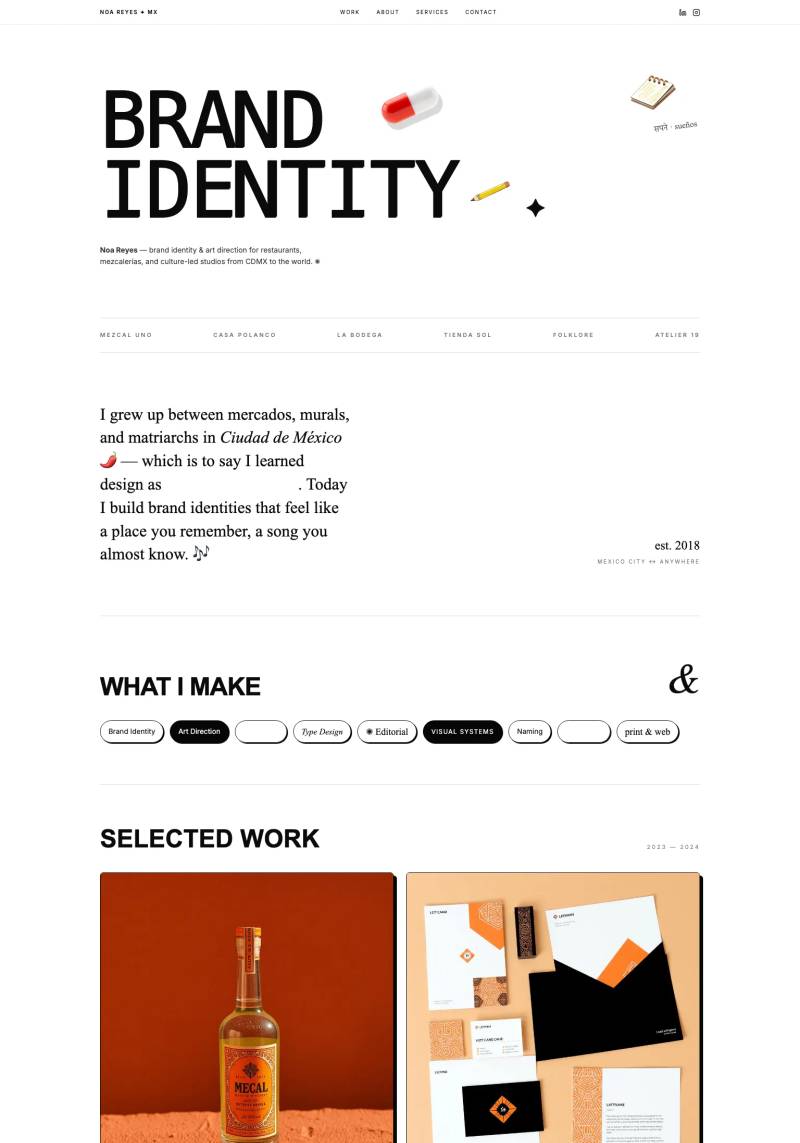
This brand identity portfolio introduces 3D objects floating through oversized typography and pairs pill-shaped service tags in mixed fill states to show editorial design depth.
 Mimic this
This creative agency site uses organic blob shapes to mask hero imagery and positions "YOUR VISION, BEAUTIFULLY CRAFTED" in bold black serif against baby blue and white sections.
 Mimic this
This graphic design portfolio arranges case studies in a masonry grid with each project on a distinctly colored rounded card—orange, purple, lime, lavender—mixing product mockups, 3D renders, and editorial work.
 Mimic this
This design agency site pairs minimalist black layouts with hyper-saturated classical and sci-fi artwork, contrasting "Crafting design with love" against vibrant baroque statues and neon observatory scenes.
 Mimic this
This branding agency site positions itself as "disruptive" by highlighting keywords—"design," "Perception," "growth"—with decorative teal underlines in the mission statement.
 Mimic this
This design studio site stacks its value proposition—strategy, branding, digital products—as three equal columns with moody photography and category labels.
 Mimic this
This UX designer portfolio embeds her photo into a tropical composite hero and layers contextual badges—"From Costa Rica," "AI Designer"—as playful floating elements.
 Mimic this
This UX/UI designer portfolio uses overlapping avatar social proof and "Framer Expert ⚡" badge to establish credibility before the pitch.
 Mimic this
This design subscription site uses italic serif typography for key words ("design," "at your doorstep") and charts testimonial quotes directly onto the hero image.
 Mimic this
This design agency site uses hot pink fluid textures in the hero and tilts portfolio images at angles with pink accent bars.
 Mimic this
This digital design studio site uses a glitchy underline on "Digital" and stacks four massive stat numbers with single-sentence outcomes.
 Mimic this
This 3D design agency site uses outlined display letters for "DESIGN" with a chrome-reflective stroke effect to anchor the hero.
 Mimic this
This branding agency site mixes serif, script, and sans-serif fonts within single headlines to create typographic friction that mirrors its "move fast, design sharp" positioning.
 Mimic this
This freelance designer portfolio uses a mystical forest illustration hero with "that" in handwritten script and a sticker-badge tagline: "From napkin sketch to Series A polish."
 Mimic this
This digital design agency portfolio arranges work in a 2-column grid with project screenshots set against dramatic dark backgrounds and blue cinematic lighting.
 Mimic this
This design subscription site splits its H1 into contrasting typefaces—bold sans "We make," paired with italic serif "you scale"—to emphasize the value exchange.
 Mimic this
Dot labs
This design agency site opens with a dramatic close-up portrait under red lighting and leads with "We're not here to decorate screens, we're here to craft thoughtful design that solves problems."
 Mimic this
This branding studio site uses a massive typographic headline—"OUR HEADS ARE ROUND SO OUR THOUGHTS CAN CHANGE DIRECTION"—with rotated sidebar category labels and chartreuse accents.
 Mimic this
This product designer portfolio uses the headline "Design so good, **it should come with a warning label**" and scatters floating UI mockups asymmetrically across the hero.
 Mimic this
This creative studio site structures its portfolio as scattered polaroid prints on black, anchored by Latin mottos and the tagline "Stories you can feel, moments you can keep."
 Mimic this
This content production studio anchors its hero with a cinematic film-set photograph and sells its value as "bridging the gap between creativity and strategy."
 Mimic this
This branding agency site splits pricing between custom projects and "The Burrow Membership," a $3,995/mo unlimited design subscription with tortoise and snail mascots reinforcing steady, reliable work.
 Mimic this
This freelance web design site opens with collage-style tape-affixed art and positions itself with "Your work is excellent / Your website doesn't show it."
 Mimic this
This design agency site opens with Renaissance engravings as a full-width frieze, contrasting classical imagery against minimal modern UI.
 Mimic this
This creative studio site opens with a surreal 3D landscape hero and introduces itself as "the aespot." with a period—a typographic choice that doubles as punctuation and design statement.
 Mimic this
This creative subscription site sells flat-rate agency work with the headline "Agency-quality. In-house speed. AI supercharged. Flat rate."
Design Data
The colors, fonts, and layout choices used across 351 design agency websites.
Background color
How dark or light the page background is (background luminance).
- White / near white 45.3% (159)
- Black / near black 33.9% (119)
- Light 8.8% (31)
- Dark 7.4% (26)
- Mid-tone 4.6% (16)
Accent color
The color of each site's primary button, measured from its code (accent hue family).
- Black, white & gray 31.4% (98)
- Amber / orange 17.3% (54)
- Blue 12.5% (39)
- Red 11.2% (35)
- Green 8.7% (27)
- Lime 7.1% (22)
- Purple 4.8% (15)
- Pink 3.8% (12)
- Teal / cyan 3.2% (10)
Hero layout
How the top section arranges its headline and imagery.
- Text above full-width media 26.2% (74)
- Centered text 24.5% (69)
- Text left, image right 17% (48)
- Text over a full-width image 17% (48)
- Asymmetric 12.4% (35)
Hero imagery
The kind of visual the top section leads with.
- Photography 35.5% (123)
- Illustration 22.3% (77)
- No imagery 19.7% (68)
- Product screenshot 15.3% (53)
- 3D artwork 7.2% (25)
Button shape
Corner rounding on primary buttons (border radius relative to height).
- Pill (fully rounded) 62.1% (41)
- Square corners 21.2% (14)
- Rounded corners 16.7% (11)
Font combination
How heading and body typefaces pair (serif vs. sans-serif).
- All sans-serif 75.5% (71)
- Serif headings, sans-serif body 23.4% (22)
- Monospace 1.1% (1)
Color intensity
How colorful the palette is, from black-and-white to bold color (saturation).
- Soft, muted color 47.9% (168)
- Black & white 37.9% (133)
- Bold, vivid color 14.2% (50)
Dark mode support
Sites whose code adapts to the visitor's light/dark preference (prefers-color-scheme).
- Yes 7.3% (9)
- No 92.7% (114)
Most-used fonts
The typeface each site leads with, read from its live CSS.
- Inter 11.7% (11)
- Poppins 5.3% (5)
- Satoshi 4.3% (4)
- Inter Tight 3.2% (3)
- Playfair Display 2.1% (2)
Percentages are the share of sites where each trait could be measured, with counts in parentheses. Last updated August 2026.
Best design agency website examples favor illustration and product shots over stock photography
Looking through the best design agency website examples, photography leads hero media on only 35.5% of sites, compared with 64.1% across the whole gallery. That’s the widest gap on the page, and it flips the usual gallery pattern on its head: illustration takes 22.3% and product mockups take 15.3%, together nearly matching photography’s share. Agencies are selling craft and visual judgment, not documenting a physical product or team, so a photo of people in an office does less work than a custom illustration or a mockup of the interface they built. Anida runs an illustrated hero, while AAOA
 , Verken
 , Jack Studios
 , dg.digital
 and Patrick Cui
 all lead with product-screenshot heroes that put the portfolio front and center.
Near-black backgrounds run nearly twice the gallery norm
Near-black backgrounds appear on 33.9% of these sites versus 18.1% gallery-wide, second only to near-white’s 45.3%. That’s a real split: agencies are choosing between stark white and near-black canvases far more decisively than the broader gallery, which spreads more evenly into light, dark, and mid tones. A near-black background reads as confident and gallery-like, letting typography and case-study imagery carry contrast. Verken, Imagem , Cristiano C
 , ZRØ
, ZRØ , Patrick Cui and Lemons Studio
 all sit on near-black grounds, while Full Circle
 , Brooke Glaser
 and Anida hold the white end of that same divide.
Full-bleed overlay heroes are a minority move in design agency websites
Only 17% of hero layouts use a full-bleed overlay, against 35.7% across the gallery, another of the sharpest departures on the page. Agencies instead lean on stacked copy at 26.2% and centered layouts at 24.5%, arrangements that separate headline from image rather than stamping text over a photograph. That fits the photography pullback above: with fewer sites treating the hero as a single dominant image, there’s less need for an overlay technique built specifically to keep text legible over a photo.
Pill buttons and muted color dominate design agency website design
Pill-shaped buttons account for 62.1% of CTAs, well clear of square at 21.2% and rounded at 16.7%, and muted palettes lead saturation profiles at 47.9% with monochrome close behind at 37.9%. Janika Jokinen , Clare Nicolson
 , Emete
 and AAOA all use pill buttons, showing the shape holds across very different palettes, from black-and-white to vivid to muted.