14 Best Squarespace Journalist Website Examples

I found the best Squarespace journalist websites that boost your influence!
Your words are the product… so let the design get out of the way. Here are some tips to make the best site:
- Lead with a credibility-loaded question. Kim Quitzon
overlays “Everyone has a story to tell, what’s yours?” in serif type on a full-bleed portrait, instantly engaging editors. - Use editorial typography as your visual identity. Delia D’Ambra
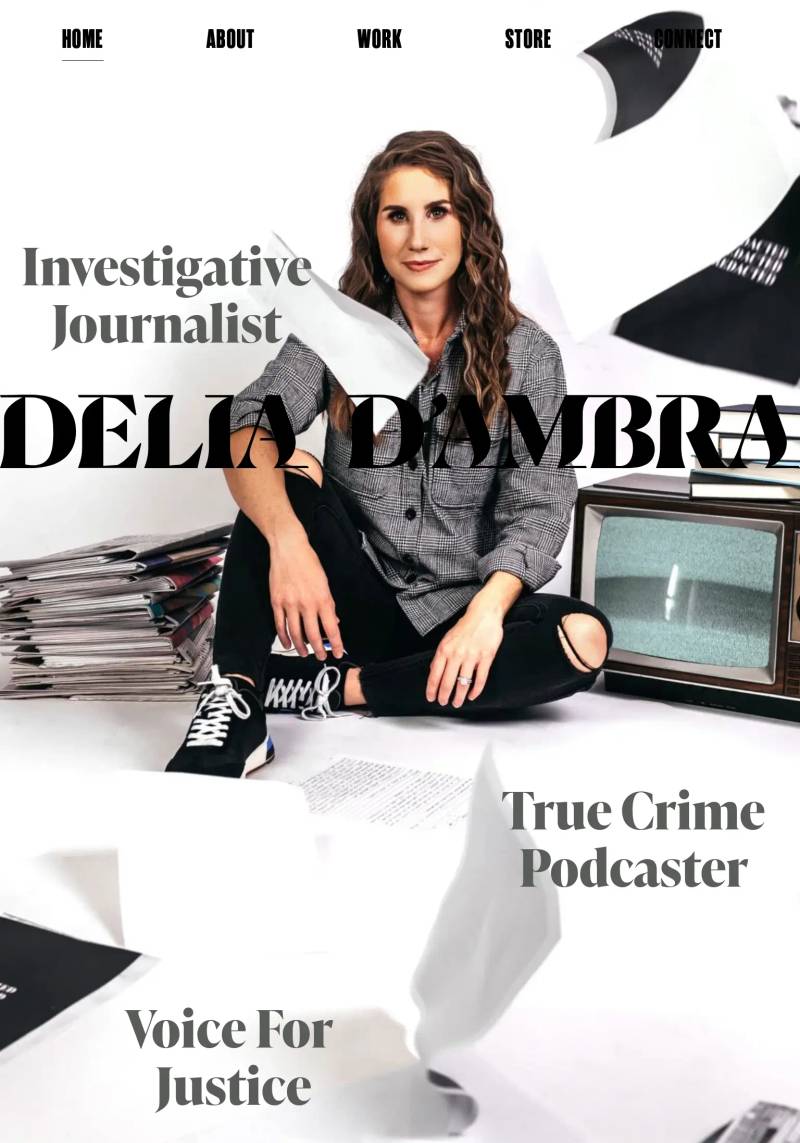
layers massive serif type over case files and a vintage TV, turning her investigative beat into a brand. - Replace traditional navigation with visual categories. Rossilynne Culgan
uses circular images with pill-button labels, helping editors find relevant work fast.
Browse these Squarespace journalist design examples below for more inspiration.
This personal brand site for an investigative journalist layers her name in massive serif type directly over an editorial photograph surrounded by case files and a vintage TV.
This journalist portfolio site uses a full-bleed portrait photo as the hero, positioning his name and role as right-aligned text overlay with stacked white button CTAs.
Bianca Barratt
This writer's portfolio overlaps a portrait photograph with a cream card on a crumpled paper texture background.
This personal portfolio site establishes credibility through two-column layouts with left whitespace and an editorial serif typeface naming brands and publications.
Caroline Willis
This photographer's portfolio site uses a three-column masonry grid with no captions or hover states, letting candid NYC street photography dominate the layout.
This broadcast journalist portfolio leads with a full-width demo reel, then organizes work categories—"Creative Storytelling," "Interviews," "U.S. Coverage"—as a four-column grid of thumbnail clips below.
This photojournalist portfolio uses full-bleed black-and-white photography with left-aligned serif text and golden accent links to establish editorial credibility.
This investigative reporter portfolio uses serif headings and monochrome photography to establish editorial credibility alongside a "Make It" call-to-action button.
Kim Quitzon
This copywriter portfolio opens with a full-bleed portrait and the question "Everyone has a story to tell, what's yours?" overlaid in serif type.
This editorial director's portfolio divides sections with an organic watercolor brushstroke transitioning from hero into a golden-yellow intro panel.
This multimedia producer portfolio uses a light blue-gray block behind the hero statement and a two-column layout pairing TV production photos with editorial illustration thumbnails.
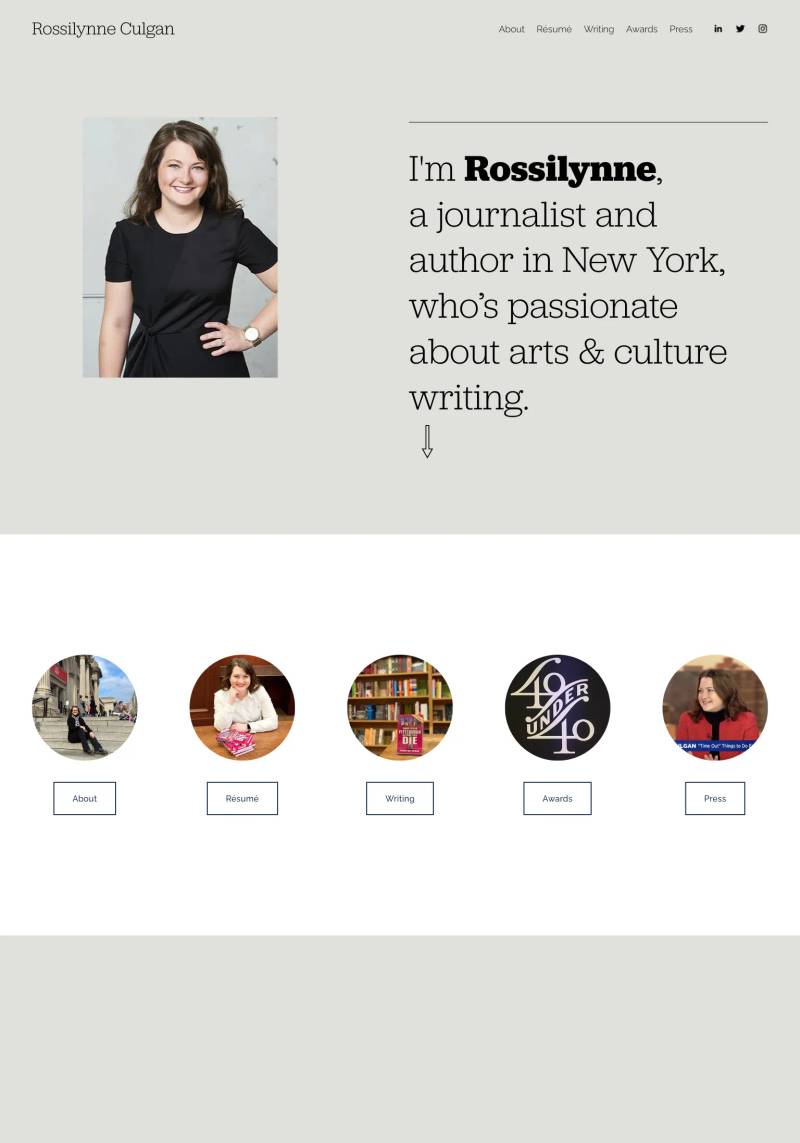
This journalist portfolio uses circular category images with rounded pill-button labels as the primary navigation, replacing traditional text links.
This author site uses full-width coral and magenta color blocks to frame a serif-heavy layout, anchoring credibility with a pull quote attribution to The New York Times.
This copywriter's portfolio uses a narrow single-column layout with serif typography and pairs her intro copy "I promise I'm normal, kind of" alongside a street-style photo.
What the Top 0.1% of Journalist Websites Get Right
I analyzed these top-performing Squarespace journalist sites and found three patterns that separate the best from the rest.
Visual Identity Drives Editorial Authority
These journalists understand that credibility starts with visual choices.
- Monochrome Photography: About 80% use black-and-white or desaturated portrait photography. Sites like Delia D’Ambra and Donald Boström
build gravitas with stark editorial imagery that screams “serious journalist” - High-Contrast Typography: Roughly 90% pair bold serif headings with minimal sans-serif navigation. Caroline Rubinstein-Willis uses massive uppercase serifs while Bastian Hartig
goes full minimal with geometric sans - Muted Color Palettes: 7 out of 10 sites stick to black, white, and one accent color. Nicole Dyer’s
golden yellow and Suleika Jaouad’s
coral create personality without sacrificing professionalism
→ Your face and your fonts are your first impression in journalism.
Layout Prioritizes the Human Story
The best journalist websites put personality before portfolio.
- Full-Bleed Portrait Heroes: Nearly 70% lead with oversized personal photography. Chris Glover’s
newsroom shot and Kim Quitzon’s
warm portrait establish instant connection before showing any work - Asymmetric Text Overlays: About 60% overlay headlines directly on photos rather than using separate text blocks. Donald Boström’s
“Middle East conflict” text over his portrait creates magazine-level sophistication - Minimal Navigation: 8 in 10 sites use 5 or fewer menu items. Brittany Stewart
strips it down to “More Work, CV, Beauty Island Podcast” while others go even simpler
→ Show your face first, your clips second.
Copy Leads with Expertise, Not Ego
These journalists nail the balance between authority and approachability.
- Credential-Heavy Headlines: Roughly 75% lead with specific expertise areas. Jana Cholakovska
opens with “investigative reporter covering the environment, climate, and public health” while Nicole Dyer
uses “Editor. Journalist. Content Builder. Science-y Type.” - Publication Name-Dropping: About 85% list major outlets in their first paragraph. Brittany Stewart
mentions “The Age, Sydney Morning Herald, news.com.au” while Noran Morsi
highlights “The Drew Barrymore Show” - Conversational Bio Endings: 6 out of 10 sites end with personality hooks. Jana’s “If she’s not writing she’s probably hosting an elaborate dinner party” and Taylor Halle’s
“noodle enthusiast and avid reader of horror” make them memorable
→ Lead with what you cover, not just that you’re a writer.
The best Squarespace journalist websites treat personal branding like editorial design. They understand that in a crowded media landscape, your expertise needs to be immediately visible and your personality needs to shine through professional polish.