66 Best Wedding Website Examples

Wedding sites are personal and temporary, so the usual homepage rules barely apply. I ran every site here through Claude. The standout pattern is how heavily the best wedding websites lean on serif body text, far more than any other category in the gallery. That traditional warmth is worth borrowing for any site that wants to feel personal, but the intimate tone rarely translates to a business homepage. Compare the examples below and notice how each one pairs its serif type with the hero photo.
Category
Platform
Style
 Mimic this
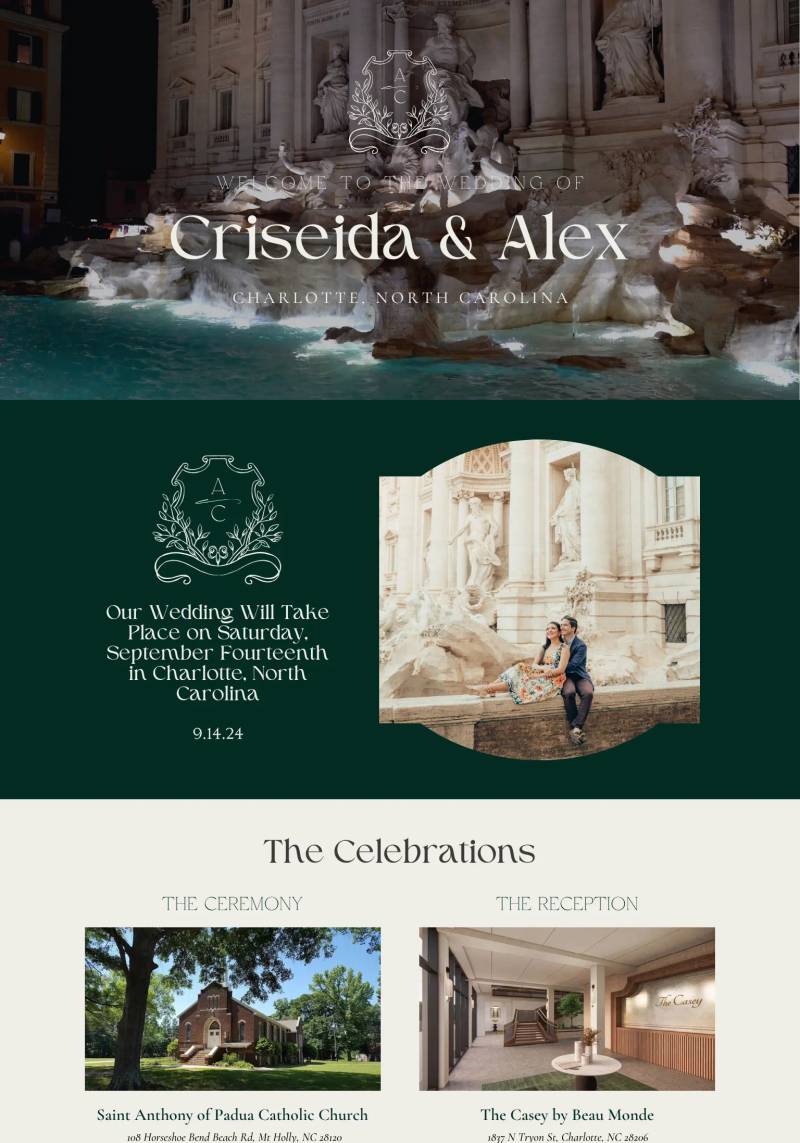
This wedding invitation site frames couple details in a scalloped-border photo and anchors the layout with a recurring monogram crest.
 Mimic this
This wedding invitation site embeds a music player beneath a Spanish love quote and uses full-bleed couple photos with forest-green sections and dove illustrations.
 Mimic this
This wedding website announces the couple's names in cursive script over a couple photo, with watercolor peach washes and hand-drawn florals framing event details in uppercase.
 Mimic this
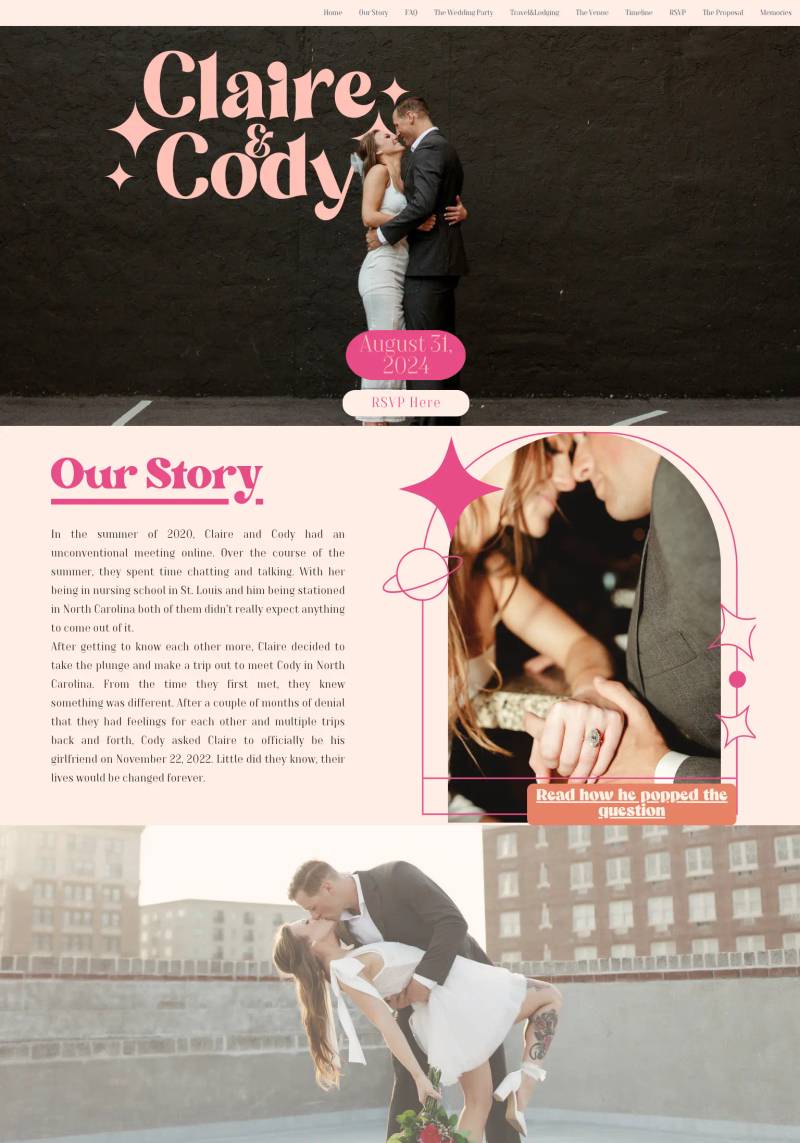
This wedding website frames couple photos with curved hot pink line art borders instead of rectangular frames, set against a peach background with retro serif display type.
 Mimic this
This wedding invitation site uses a clothesline with polaroid photos and watercolor blotches to frame the couple's 12-year story.
 Mimic this
This wedding site centers the couple's names in a rotated diamond frame adorned with Chinese double-happiness symbols and flanking Indian elephants in coral-red.
 Mimic this
This wedding site uses a two-column hero with couple photo and script heading, then alternates sage-teal-mint background blocks for timeline and story sections.
 Mimic this
This wedding website overlays calligraphic script on golden-hour couple photography, then transitions to a parchment-textured invitation with serif typography and envelope icon for RSVP.
 Mimic this
This wedding save-the-date uses arch-shaped photo frames with watercolor lemon branches and "Recuerda es puntual!" to frame a Cabo San Lucas destination wedding.
 Mimic this
This destination wedding site organizes guest logistics through pill-shaped link buttons and a black-and-white couple photo with serif typography overlay.
 Mimic this
This wedding invitation site uses watercolor botanical corner illustrations and polaroid-style photo cards tilted at different angles to create intimacy.
 Mimic this
This wedding site opens with a beach photo and staggered serif typography, then uses botanical illustrations and sand textures to separate faith-centered love story sections.
 Mimic this
This wedding website uses a serif-forward layout with maroon accent blocks to frame the couple's story: "Two souls from opposite sides of the world ended up at the same church conference."
 Mimic this
This wedding site anchors the couple's names in champagne serif type flanking a circular "&" badge stamped with "WE ARE GETTING MARRIED."
 Mimic this
This wedding site organizes a three-day Cancún celebration across itinerary cards with inset dotted borders and rust-colored event headers on a sandy gradient.
 Mimic this
This wedding invitation site uses hand-drawn watercolor illustrations of the couple and château, with gold accents and script typography throughout.
 Mimic this
This wedding site organizes a three-day Lisbon celebration with event cards, countdown timer, and trilingual navigation in olive-green and cream.
 Mimic this
This wedding invitation site layers fashion editorial photography with handwritten script overlays and a Polaroid-taped polaroid snapshot against dusty rose backgrounds.
 Mimic this
This wedding site anchors the couple's names in a massive serif headline overlapping the hero image, with navigation and date details positioned as small cream text in opposite corners.
 Mimic this
This wedding site pairs a moody black-and-white hero with brush-script names and asymmetric photo grids using crossed-line dividers between warm-toned event imagery.
 Mimic this
This wedding site layers a black-and-white couple portrait with gold-framed arch photography and a biblical quote in italics to structure the invitation.
 Mimic this
This destination wedding site layers event details over black-and-white couple photos in a two-column grid, using wide letter-spacing and script calligraphy for "Itinerario" headings.
 Mimic this
This wedding invitation site frames the couple's names with a stylized gold ampersand and ornamental dividers separating "WE INVITE YOU TO OUR WEDDING" across cream backgrounds.
 Mimic this
Nkosie and Mitchie
This wedding site uses a forest-green navigation bar with an orange "RSVP" button, couple names in italic script, and a four-column stats grid quantifying their relationship.
 Mimic this
This wedding invitation site uses a fixed navigation with monogram and letter-spaced all-caps labels, pairing serif script headlines with full-width black-and-white vineyard photography.
 Mimic this
This wedding invitation site centers the couple's names in swash-serif caps above a full-width black-and-white portrait, flanked by hand-drawn burgundy peonies.
 Mimic this
This wedding website overlays a centered serif logo and dual CTAs on a hero photo, then repeats the button pair in an info section with gold botanical corner ornaments.
 Mimic this
This wedding invitation site layers couple portraits over classical estates and uses a decorative Cyrillic script heading with a single amber accent dot.
 Mimic this
This wedding site intersperses couple photos with custom watercolor illustrations of their Newfoundland dog and tortoise in Austin landmarks.
 Mimic this
This wedding site centers the couple's names in massive serif across the hero photo, with navigation and dates positioned as small overlays.
Design Data
The colors, fonts, and layout choices used across 66 wedding websites.
Background color
How dark or light the page background is (background luminance).
- White / near white 60.6% (40)
- Light 19.7% (13)
- Mid-tone 13.6% (9)
- Black / near black 4.5% (3)
- Dark 1.5% (1)
Accent color
The color of each site's primary button, measured from its code (accent hue family).
- Black, white & gray 45.3% (24)
- Amber / orange 24.5% (13)
- Red 17% (9)
- Pink 5.7% (3)
- Green 3.8% (2)
- Teal / cyan 1.9% (1)
- Blue 1.9% (1)
Hero layout
How the top section arranges its headline and imagery.
- Text over a full-width image 63.9% (39)
- Text above full-width media 16.4% (10)
- Text left, image right 8.2% (5)
- Centered text 6.6% (4)
- Image left, text right 3.3% (2)
Hero imagery
The kind of visual the top section leads with.
- Photography 87.9% (58)
- Illustration 7.6% (5)
- No imagery 3% (2)
- Video 1.5% (1)
Color intensity
How colorful the palette is, from black-and-white to bold color (saturation).
- Soft, muted color 68.2% (45)
- Black & white 22.7% (15)
- Bold, vivid color 9.1% (6)
Dark mode support
Sites whose code adapts to the visitor's light/dark preference (prefers-color-scheme).
- Yes 7.1% (2)
- No 92.9% (26)
Percentages are the share of sites where each trait could be measured, with counts in parentheses. Last updated August 2026.
Best wedding website examples lean serif far more than the average site
Serif body copy appears on 43.1% of these pages, against just 7.5% across the gallery as a whole. That is not a stylistic accident. Wedding sites are invitation objects first and websites second, and a serif body typeface (paired here with display or serif headings) carries the tone of a printed save-the-date onto a screen. Stephen Marys Kathryn and Bride & Blossom
 both set their pages in Playfair Display, and Bring Joy
 pushes the same instinct further with Cormorant Garamond, giving the whole page a formal, engraved-card feel rather than a software-product one. Anyone building in this niche should treat sans-serif body text as the safe default it is elsewhere and recognize that going serif is how a wedding site signals occasion rather than utility.
Full-bleed photo heroes are the default, not one option among several
Full-bleed overlay heroes account for 63.9% of measured layouts here, well above the 35.7% seen gallery-wide, and photography drives 87.9% of hero media against a 64.1% baseline. The two stats reinforce each other: couples want their engagement photos to be the first thing a guest sees, uninterrupted by a split panel or a boxed image. Patricia y Esteban , Adam and Ruby
 , and Bea y Jose
 all put a photograph behind the fold with copy layered on top, and the pattern holds whether the palette is muted, black-and-white, or vivid, as with Gabriela & Jakob
 and Celebrate the Adventure 2024
 . A builder skipping the full-bleed photo hero here is working against the grain of the niche, not with a neutral alternative.
Color stays quiet even when accents show up
Neutral leads the accent palette at 45.3%, with amber a distant second at 24.5% and red at 17%. Saturation follows the same restraint: muted tones cover 68.2% of sites and monochrome another 22.7%, leaving vivid palettes at just 9.1%. Buttons in black or white dominate examples like Forbes Weddings and Svatba Miroslav & Klára
 , while the rare red accents on Vowsheets
 and Tiied
 or amber on Marknes
 register as departures rather than the norm. This tells a builder that a wedding site’s color job is to frame the photography, not compete with it, and that even a single saturated accent button reads as a deliberate choice against a field of near-white and black-and-white pages.