13 Best Networking Website Examples

I found the best networking website examples that grow your connections!
The strongest networking sites ditch stiff corporate vibes for warmth and authenticity that makes joining feel like belonging. Here’s what actually works:
- Lead with community identity, not features. Grandview
puts neighborhood heart front-and-center with bold copy that turns belonging into a call to action. FBomb Breakfast Club
uses punchy values and full-width heroes to make entrepreneurial women feel seen immediately. - Use color psychology to signal your vibe. Nabo’s
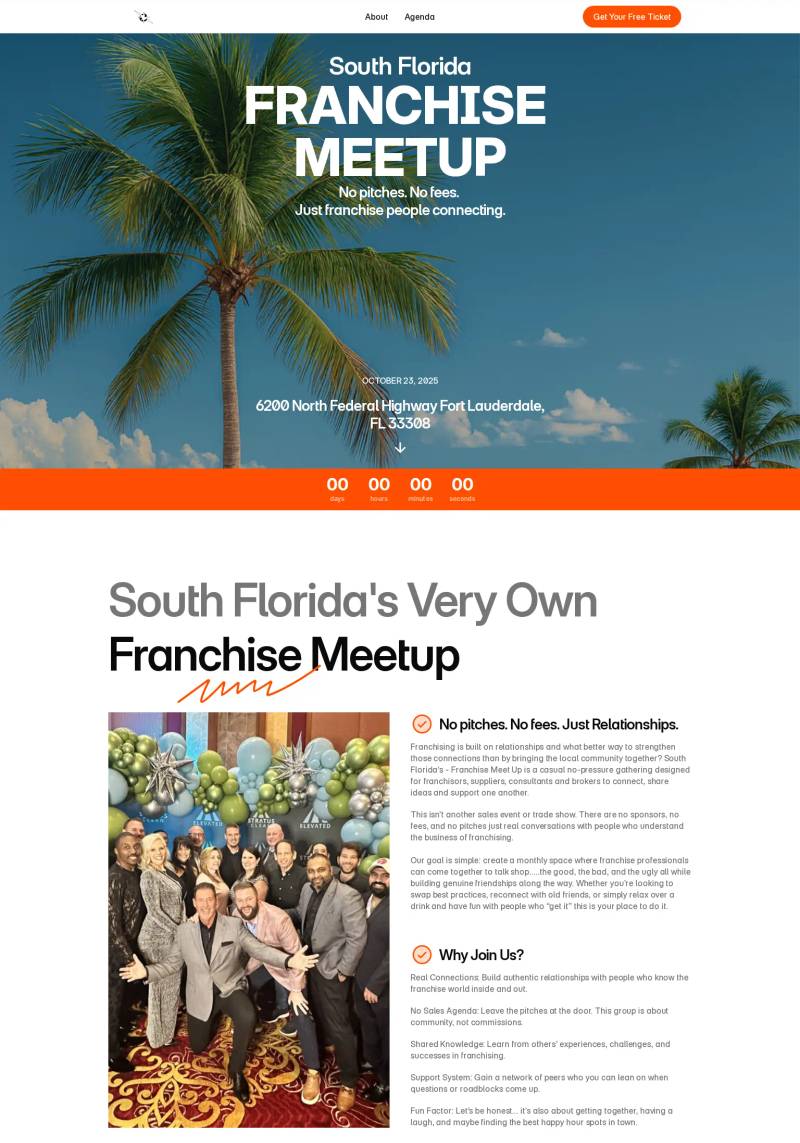
bold purple creates approachable modernity for neighborhood sharing. The Franchise Meetup
pairs teal and orange for tropical warmth plus professional credibility. Quirc’s
purple-white-red palette screams inclusive energy. - Show real people, real stories. Swing and Sip
nails approachability with authentic lifestyle photos. Redwood
combines clean design with founder storytelling. Fanfix
creates safe space by celebrating diverse voices upfront.
Let’s look at some networking design inspiration…
This franchise event landing page leads with a tropical hero image and countdown timer, using hand-drawn orange squiggles to underline key phrases like "No pitches. No fees. Just Relationships."
This social golf club site uses a marquee ticker repeating "GOLF / SWING / SIP" and positions the tagline "From Lisbon to London" as the core brand narrative.
This founder community site leads with "For founders who see the world differently." and uses maroon pill buttons labeled "Request invite" to gate access.
This membership community site uses duotone teal photography, torn-paper handwritten graphics, and a scrolling value ticker to position peer-led business support as unapologetically feminist.
This LA marketplace site announces its value with "BOLD BRANDS BY ANGELENOS" in massive black caps, then repeats the tagline in a yellow marquee stripe.
This community platform landing page leads with "More than an app – Join our community. Join the movement!" and structures value through Match-Create-Engage pillars in a three-column grid.
This sharing economy site sells "we are enough" with annotated product photos and a horizontal-scroll grid of borrowable items.
This HOA neighborhood site uses a hero photograph of the residential entrance sign and pairs "Welcome Home" with a quote about finding room within national parks.
This Norwegian summer festival site uses hand-drawn orange illustrations and staggered photo grids to sell "uforglemmelige sommerminner" across music, activities, and coastal experiences.
Depths
This tech bookmarking site displays fanned bookmark cards with overlapping 3D rotation and asks "So... how can Depths help me?" to transition into features.
This creative community site leads with "Everyone is creative" in large italic serif and sells scale through a single statistic: "245 cities across 70 countries, for free."
This creator-monetization site uses staggered profile card grids with hot pink and neon yellow accent blocks, and positions "$1 million each month" as linked text.
This neighborhood association site uses a forest green announcement bar and orange hero with serif typography to establish local identity around "the Neighborhood with HEART."
What the Top 0.1% of Networking Websites Get Right
I analyzed these networking websites and found distinct patterns that separate the standouts from the sea of generic community platforms.
Visual Identity: Bold Color Psychology and Cohesive Brand Systems
The most successful networking sites use color as a strategic tool, not decoration.
- High-contrast duotones dominate: About 80% use bold two-color schemes like F*Bomb’s teal-salmon combo or Swing and Sip’s
dark green-orange pairing. Made in LA
and Fanfix
push this further with 4-5 color systems that still feel cohesive. - Warm backgrounds signal approachability: Roughly 70% choose cream, beige, or warm off-white backgrounds rather than stark white. Nabo
and Grandview
use this to make their platforms feel more like home than corporate networking. - Custom illustration over stock photography: 9 out of 12 sites feature hand-drawn elements, organic shapes, or custom graphics. Grandview’s
neighborhood illustration and Made in LA’s
scattered palm trees create memorable visual hooks that stock photos can’t match.
→ Color psychology drives first impressions, and these sites treat their palettes like strategic assets.
Layout and UX: Hero Sections That Actually Convert
These networking platforms have cracked the code on hero sections that work for community building.
- Problem-first headlines win: About 75% lead with the user’s pain point rather than the solution. “For founders who see the world differently” (Redwood
) and “Everyone is creative” (CreativeMornings
) acknowledge the user’s current state before pitching membership. - Social proof through real member showcases: Fanfix
displays actual creator earnings while Depths
shows genuine bookmarked content. This beats generic testimonial carousels every time. - Waitlist CTAs create urgency: Roughly 60% use “Join waitlist” or “Apply” instead of “Sign up.” Quirc
and Depths
position exclusivity as a feature, not a barrier.
→ The best networking sites sell the transformation, not the features.
Copy and Messaging: Community-First Language That Builds Trust
The messaging patterns reveal how top networking sites position themselves as movements, not platforms.
- Inclusive pronouns dominate: About 85% use “we,” “us,” and “our” in headlines rather than “you” language. F*Bomb’s “AN OUTRAGEOUSLY EFFECTIVE BIZ GROUP FOR AND LED BY MEMBERS” makes users feel like co-creators, not customers.
- Location-specific value props: Sites like Made in LA
(“BOLD BRANDS BY ANGELENOS”) and Grandview
(“the Neighborhood with HEART”) use geographic identity as differentiation. This beats generic “global community” messaging. - Vulnerability-forward positioning: The strongest sites acknowledge struggle upfront. Redwood’s
“founders who see the world differently” and Quirc’s
focus on marginalized communities create immediate emotional connection through shared challenge.
→ The most effective networking sites position membership as identity, not utility.
Stop treating your networking platform like a feature list. The top performers understand that people join communities to become better versions of themselves, and every design choice should reinforce that transformation.