150 Best Colorful Website Examples

I found the best colorful websites to share for inspiration. Only 0.1% of reviewed website designs make it onto this list! Each website example includes a tall screenshot, a link to the live site, and the platform it was built on.
This co-living landing page pairs pastoral hero photography with lime-chartreuse accent buttons and offers naming rights to chickens as a booking incentive.
This design subscription site splits its H1 into contrasting typefaces—bold sans "We make," paired with italic serif "you scale"—to emphasize the value exchange.
This DeFi event site uses gradient-filled display type with halftone dot patterns and bright green accent highlights to announce "Uniday unites builders to explore the future of the onchain economy."
This illustrator and designer portfolio stacks neon grid boxes, decorative serif typography, and cartoon characters to sell "playfulness" as a core skill.
This creative agency site uses sticker badges ("Trending," "Creative," "Fast") layered onto oversized serif letterforms in the hero.
This coconut water brand site uses wavy section dividers and floating product cans against bright cyan and yellow backgrounds to convey tropical energy.
This baby furniture site uses "designed for real life" as hero text and organizes products through lifestyle imagery rather than spec sheets.
This UX designer portfolio uses colored accent pills and chat bubbles to position consulting as a two-way conversation.
This crypto wallet site sells security through playful 3D illustrations and command palette shortcuts, leading with "Experience Crypto in Color."
This vegan cheese DTC site uses puns as section headers—"Shop Our Grate-est Hits" and "Gouda for Everyone"—pairing them with hand-drawn botanical details.
This jarred-beans DTC site leads with "Follow your impulse to better beans" and uses a playful bean mascot and circular UI elements throughout.
This skincare e-commerce site embeds a product photo inside the hero headline's "O" and repeats "Combination Of East & West" across a scrolling marquee.
This oat drink brand site leads with hand-drawn serif headlines over scattered white clouds and a sold-out marquee banner announcing production limits.
This organic baby food site uses a split-color hero background displaying four product boxes at angles, with a scrolling trust bar below featuring pediatrician credentials.
This functional beverage brand site uses a scrolling marquee with oversized "YERBA MATE" text and hot pink product cards stacked on crushed ice imagery.
This coaching site sells mindset transformation with neon magenta headings, lime green CTAs, and the tagline "THE SPACE WHERE PROBLEMS BECOME CHAMPAGNE PROBLEMS."
This non-alcoholic craft beer site uses colorblock product photography—each beer variety photographed against its own branded color—and headlines set in bold italic serif capitals like "CRAFT BREWED. ALCOHOL REMOVED."
This plant-based meat brand site uses stacked bold condensed typography with "EAT LIKE AN ANIMAL" over a circular plate image and infinite yellow-text marquee strips on red.
This ice cream site uses distressed condensed display type and neon lime accents against macro photography, positioning lactose-free dairy as "PROBABLY THE BEST ICE CREAM EVER."
This French teaching resources site uses a vibrant orange-yellow hero gradient paired with hot pink CTAs and a playful collage of illustrated school supplies and an Eiffel Tower.
This brand design studio site uses a scrolling "BOOKING NOW ✦ 2026" marquee and scatters hand-drawn stickers (flowers, stars, blobs) across a cream background with pink and green accents.
This freelance designer site uses tilted yellow mockup cards, hot pink speech bubbles, and italic keywords with cream highlight pills to sell personality-driven branding.
This creator education site emphasizes italicized keywords—"empowers" and "sway"—in chartreuse against dark backgrounds and uses a scrolling marquee banner to reinforce messaging.
This entertainment PR agency intersperses neon yellow-green service words between photo thumbnails in the hero, creating a typographic collage.
This bubble tea kit shop uses a sold-out announcement bar and scalloped wave dividers to signal limited drops and exclusivity.
This cocktail mixer site uses a scrolling "IT'S YOUR MIX" magenta banner and split-screen sections with nutritional callouts to sell pre-portioned infusion sachets.
This specialty coffee shop uses a countdown timer header and pairs playful hand-lettered headings like "Savor every sip" with dessert-flavored blends packaged in kawaii cartoon illustrations.
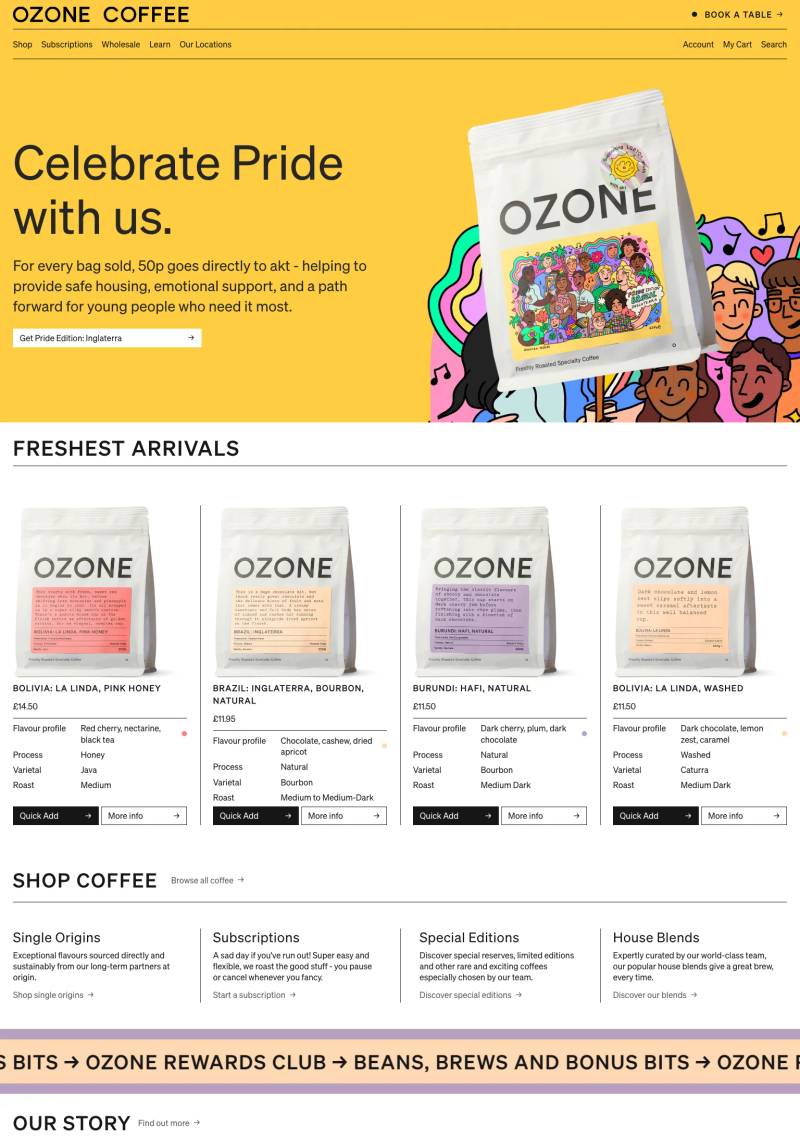
This specialty coffee retailer pairs a golden-yellow Pride campaign hero with a four-column product grid showing flavor profiles, process, and roast attributes in micro-typography tables.
This coffee alternative DTC site organizes product discovery around wellness outcomes—"calm, focused energy" and "faster, deeper sleep"—using filter pills instead of ingredient lists.
CTRL COFFEE
This coffee shop site stacks full-width sections in bright yellow and red, each pairing a chunky condensed heading with a rotated product photo and pink starburst CTA badge.
What the Best Websites Actually Do Right
After analyzing the best of the best websites, I can tell you the patterns that separate the winners from everyone else. Let me break this down…
Cross-Category Patterns
Conversion vs. Visual vs. Trust-Building Approaches
Here’s what I noticed… SaaS websites like LeoAds
and Dimension
go all-in on conversion. LeoAds uses a massive dashboard screenshot with purple glow effects, while Dimension leads with “Join waitlist” buttons everywhere. They’re not trying to be pretty. They’re trying to get you to sign up.
But look at design portfolios like Ramachandran
and Nizarali
. Ramachandran replaces typography letters with 3D pill illustrations and pencil icons. Nizarali floats UI mockup cards around his portrait photo. These sites prioritize visual impact over immediate conversion because their goal is to showcase creative ability.
AI companies like Theo
and Reworked.AI
split the difference. They build trust first with certification badges and press mentions, then hit you with the conversion elements. Theo shows “ISTE Certified” and “Apple Partner Certified” badges before asking you to try the product.
Industry-Specific Hero Formulas
Cryptocurrency sites like Blackalgo
use dark themes with neon accents and floating tech graphics. The hero promises specific returns: “11.56% Tax-Free Return” for Whisky Cask Club
, “The world’s best AI to trade BTC & ETH” for Blackalgo.
Meanwhile, design agencies like Lué Studio
and Tinkr
lead with philosophical statements. Lué calls themselves “Alchemists of the Internet” with dreamy cloud backgrounds. Tinkr promises “Your studio, finally running smoothly” with warm beige backgrounds and serif typography.
The pattern? Financial sites lead with numbers. Creative sites lead with vision.
Cross-Platform Patterns
Framer’s Animation Advantage
Sites built on Framer consistently use the most sophisticated animations and interactions. Whisky Cask Club
has that scrolling text ticker with fade-out effects. Ramachandran floats those UI mockup cards with glassmorphism. Tinkr overlays stat cards on vibrant floral photography with frosted glass backgrounds.
You just can’t get this level of interaction on Shopify. MCHNSM Skateboards
keeps it brutally simple with monospace fonts and zero border-radius because Shopify’s animation capabilities are limited.
Next.js for Developer Credibility
Next.js sites like Supabase
and Next.js itself use technical terminology and code snippets prominently. Supabase shows “npx create-next-app@latest” right in the hero. These platforms signal technical competence through their very existence.
Astro sites like Hipe
can achieve similar effects but with better performance. Hipe uses that 3D wireframe text echo effect that would kill load times on other platforms.
Platform-Specific Design Languages
Qwik sites like Dimension and Blackalgo both use dark themes with gradient accents and glassmorphism. There’s an emerging Qwik aesthetic that’s very sci-fi and developer-focused.
Sanity sites like Roboto Studio
embrace editorial layouts with generous whitespace and sophisticated typography hierarchies. The CMS influences the design approach.
Universal Trends
The Death of Generic Stock Photography
Not a single featured site uses traditional stock photos. Lué Studio
creates custom cloud photography. Tinkr
uses vibrant wildflower fields. Whisky Cask Club
shows actual whisky casks in warehouses.
Even portfolio sites like Nizarali
use personal photography integrated with UI mockups. The message is clear: custom visuals or go home.
Pill-Shaped Everything
Every single site uses pill-shaped buttons (border-radius 20px+). Dimension
uses pills for CTAs. Browser Supply
uses pills for template badges. Framer University uses pills for navigation.
But the best sites vary their border-radius strategically. Z42 Labs uses 4px for technical buttons but 8px for the logo shield. MCHNSM uses 0px everywhere for that brutalist aesthetic.
Gradient Text as Premium Signal
Premium sites use gradient text sparingly but effectively. Dimension
uses orange-to-pink gradients for key phrases. Hipe uses red-to-yellow gradients for the brand name. Nizarali
uses gradients for skill tags.
The pattern? Gradients highlight the most important 1-2 elements, never everything.
Strategic Guidance
When to Choose Framer vs. Next.js
Choose Framer when you need sophisticated animations and don’t have a developer. Ramachandran
, Whisky Cask Club
, and Tinkr
all achieve complex interactions without code.
Choose Next.js when you’re building for developers or need serious performance. Supabase
and Huly
target technical audiences who expect code snippets and technical credibility.
Platform Limitations and Workarounds
Shopify forces you into e-commerce patterns. For brands looking to tell better stories, it’s best to pair Shopify with a headless CMS like Sanity. MCHNSM Skateboards
embraces this limitation by going full brutalist with table layouts and monospace fonts. They make the constraint into a feature.
Squarespace limits customization, so successful Squarespace sites focus on content and photography over complex layouts. The featured Squarespace sites prioritize editorial content.
Category-Platform Sweet Spots
AI companies work best on Framer or Next.js. Theo
(Replit) and LeoAds
(Framer) both achieve that polished SaaS aesthetic.
Design portfolios dominate on Framer. Ramachandran
and Nizarali
prove you can build stunning portfolios without touching code.
What Makes the Best Sites Stand Out
Typography That Actually Works
Ramachandran
mixes pixel fonts, serif, sans-serif, and handwritten script in a single hero section. Most designers would call this chaos. But it works because each typeface serves a specific purpose: pixel for “Creative,” slab serif for “PRODUCT,” and decorative replacements for letters.
Lué Studio
uses a high-end editorial serif (likely Playfair Display) at 80-90px with subtle glow effects. The typography feels expensive because it is expensive. They’re not using system fonts.
Z42 Labs
pairs monospace headings with clean sans-serif body text. The monospace signals technical competence while remaining readable. Most tech sites get this wrong by using monospace everywhere.
Color Psychology Beyond Brand Guidelines
Blackalgo
uses teal (#00d4aa ) for AI elements, green for profits, red for losses, and purple for ETH branding. Each color carries semantic meaning in the crypto trading context.
Tinkr
uses olive/sage green (#5B6B2D ) for the word “smoothly” in their hero. It’s not their brand color. It’s the color of calm and growth, which reinforces their message about eliminating chaos.
Whisky Cask Club
uses warm amber tones from the actual whisky imagery, then coral/salmon (#E85D4A ) for section labels. The colors come from the product, not a style guide.
Spacing That Creates Hierarchy
Z42 Labs
uses 60px padding-top for the hero, 40px between sections, and 24-30px between paragraphs. The mathematical progression creates rhythm.
Lué Studio
uses 80-120px between major sections with 60% viewport height for the hero. The generous spacing signals luxury and confidence.
MCHNSM
uses tight 10-20px spacing everywhere for that brutalist, compressed aesthetic. The constraint is intentional and consistent.
Content Strategy That Actually Converts
Whisky Cask Club
leads with specific numbers: “11.56% Tax-Free Return in 2024” and “£150 million has been invested.” They don’t say “great returns.” They prove it.
Theo
addresses a specific pain point: “The agentic TA that turns your teaching goals and to-do list into done tasks.” They’re not selling AI. They’re selling time back to teachers.
Z42 Labs
uses philosophical language: “ENGINEERED FOR INFINITY TRAINED FOR THE UNKNOWN.” It sounds like sci-fi because their audience (enterprise CTOs) wants to feel like they’re buying the future.
Visual Hierarchy That Guides Attention
Dimension
uses a subtle purple glow around their dashboard screenshot. Your eye goes there first, then to the hero text, then to the CTA buttons. The glow creates a visual funnel.
Browser Supply
uses colored badges (green “NEW”, orange “POPULAR”, red “BEST SELLER”) to create urgency and social proof without being pushy about it.
Nizarali
floats UI mockup cards at various angles around his portrait. The asymmetry creates visual interest while the portrait remains the focal point.
Copywriting That Sounds Human
Tinkr
writes: “We eliminate admin work, fix broken processes, and build automated systems that give your team clarity and speed.” Notice the parallel structure and active verbs. They don’t say they “facilitate optimization.”
Lué Studio
calls themselves “Alchemists of the Internet” and talks about “turning base metal into pure gold.” The metaphor is extended throughout the copy, creating a consistent voice.
MCHNSM
writes: “LIFE IS TOO SHORT TO TAKE YOURSELF SERIOUSLY.” It’s all caps and brutalist, but the message is surprisingly philosophical for a skateboard brand.
Forget The Manual Build
So, you're looking at all these patterns and feeling overwhelmed by the technical details. Actually, you should just forget about them.
Let me break this down... I've built a way to let AI handle the heavy lifting for you instead.
Here is how we do it:
- Select the designs you actually like from the list.
- Add a few sentences of context about your business.
- Let my tool generate a custom, technical prompt based on your taste.
It sends that prompt straight to Lovable. And you’ll have a pro site published in the next 10 minutes just by using prompts.
I'm ditching the old way of building for this... it just clicks. Stop worrying about the "how" and just get your vision live.