40 Best Music Producer Website Examples

Music producer sites have to sell sound on a silent screen, and that constraint shapes every design decision on the page. The best music producer websites lead with photography far more often than sites in other categories. That’s what came back when I ran each one through Claude. Check that pattern across the examples below, and let it settle one question early: your homepage photo matters more than your audio player.
Category
Platform
Style
 Mimic this
This music production site uses blue waveform visualizations and stem mixers to showcase audio work, positioning composition as a technical, collaborative process.
 Mimic this
This sound design studio site uses an italicized, gold-accented word in the headline and a cursor-reactive waveform visualization as brand signatures.
 Mimic this
This singer-songwriter site overlays the album title "Tipsy Talkin' Out Now" across a hero photo with social icons and embeds a streaming player in a two-column layout below.
 Mimic this
This wedding music service site sells custom songs through watercolor illustrations of couples in golden wildflower fields and tilted polaroid frames.
 Mimic this
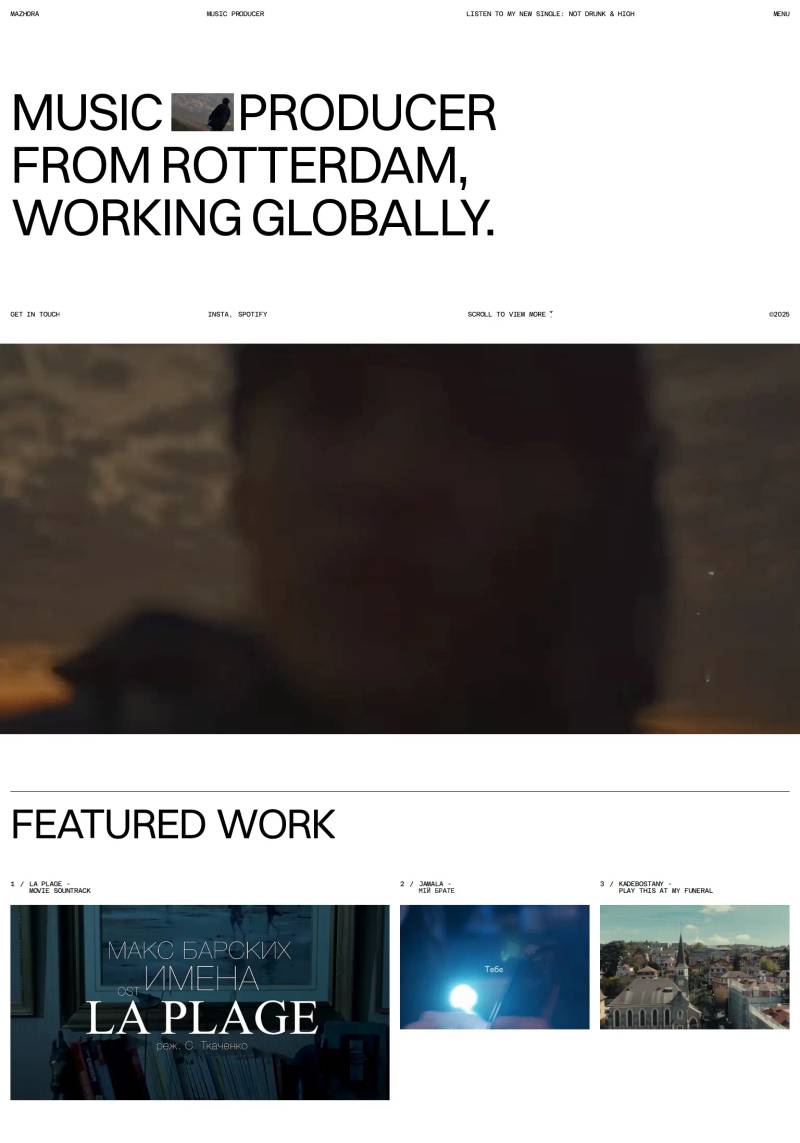
This music producer portfolio uses a reversed speaker icon mid-headline and announces releases in the top navigation bar instead of a hero section.
 Mimic this
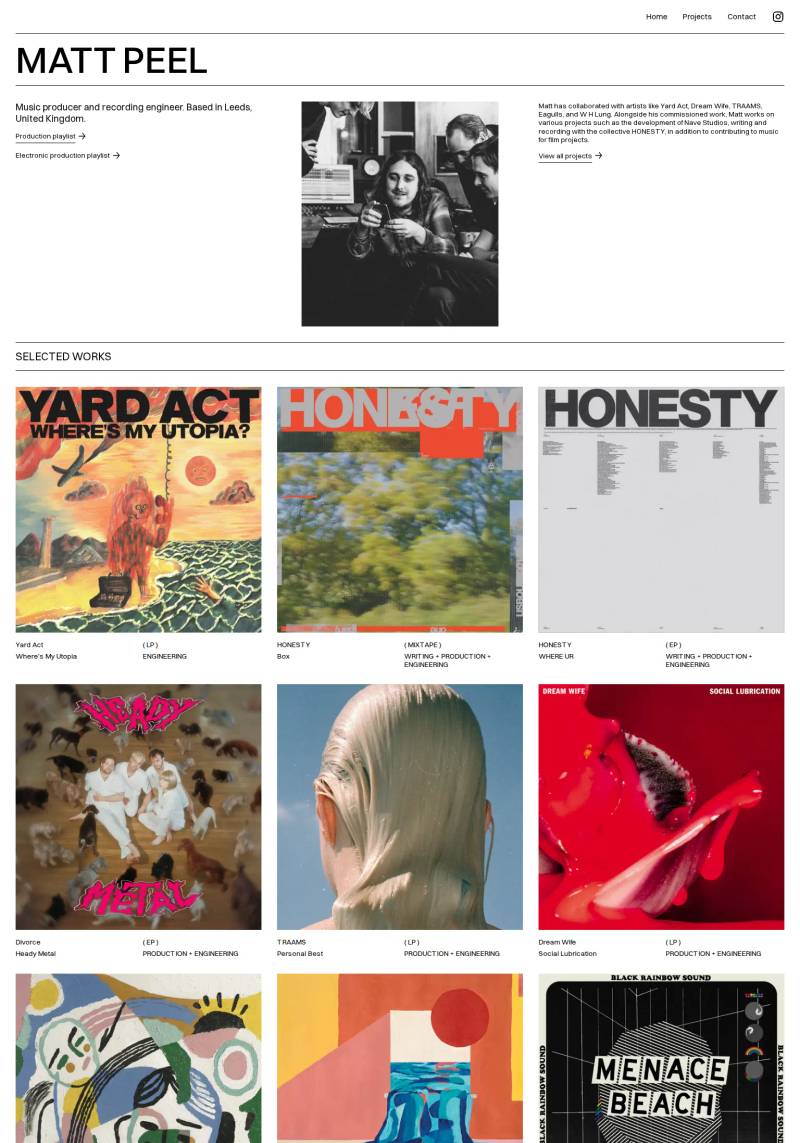
This music producer portfolio uses a three-column hero layout pairing name and red CTA links with studio photography and collaborator credits.
 Mimic this
Ambitiouz Entertainment
This music label site leads with oversized "AMBITIOUZ" typography and arranges artist photos in asymmetrical grids lit by neon red and blue.
 Mimic this
This music studio site organizes mixing, mastering, and vinyl services as a photo grid with overlaid all-caps labels and embeds client album artwork.
 Mimic this
This music platform site uses a radial gradient glow emanating from center-bottom and layered concert photography in an asymmetric grid with a play button overlay.
 Mimic this
This collaborative DAW site uses floating role badges ("Drummer," "Producer," "Rapper," "Singer") scattered around the hero and cyan waveforms in the interface mockup to sell real-time music production.
 Mimic this
Spice Girls
This music legacy site uses halftone-dotted purple-magenta text overlay on the hero and organizes catalog/merch across two-column content cards.
 Mimic this
This nerdcore music artist site structures content as colored ticket cards with thick borders and overlays copy with diagonal "MUSIC" and "VIDEO" text banners.
 Mimic this
This band merch site uses a peach-to-purple gradient backdrop with product cards bordered by mint-green accent bars labeling each item.
 Mimic this
This music platform site uses a near-black background with soft green accents and square thumbnail cards in horizontal carousels to showcase live sessions.
 Mimic this
This product leader's portfolio uses yellow highlights under role descriptors ("product leader", "founder", "creative professional") within body copy rather than traditional visual hierarchy.
 Mimic this
B P
This audio producer portfolio splits dark textured hero with white serif name against a light three-column grid of SoundCloud players organized by service type.
 Mimic this
This music producer portfolio uses a two-column hero with stacked role titles separated by rules, placing portrait and contact info asymmetrically.
 Mimic this
This mix engineer portfolio uses a cinematic warm-toned hero image with "I WANT TO HELP YOU MAKE MORE MUSIC" in bold serif caps.
 Mimic this
Devin Malloy
This musician's portfolio uses a split hero—portrait flush-left on charcoal, biography in serif italics on white—to separate performer from practice.
 Mimic this
This DJ portfolio contrasts psychedelic purple swirl patterns in the hero with blackletter typography and a desaturated cutout photo of the artist.
 Mimic this
This electronic music producer site anchors the value proposition in a Spotify stat: "among the top 3% of artists on Spotify."
 Mimic this
This mixing engineer's portfolio scatters navigation across white space with handwritten annotations like "(get a quote!)" and a cave photograph as the visual anchor.
 Mimic this
This DJ artist site leads with a concert photograph, then anchors attention with a red-orange booking bar stating "Bookings & Management" and contact email.
 Mimic this
This music producer site uses a full-viewport hero with Drew Mantia's portrait holding synthesis gear and a teal-to-dark gradient, topped by a transparent all-caps navigation bar.
 Mimic this
This DJ/producer site anchors the hero with a Paul Oakenfold endorsement quote and stacks release cards pairing vinyl mockups with warm-toned album artwork.
 Mimic this
This music producer site layers a dark mixing-console hero with a cream content area below, embedding a Spotify podcast player that overlaps the transition.
 Mimic this
Moun Sounds
This music composition studio uses horizontally scrolling marquee text in its hero and a cinematic 2-column video grid to showcase scoring work.
 Mimic this
This recording studio site uses scattered oversized brand letters as hero background decoration and underlines specific words in its value proposition.
 Mimic this
This band site uses a dark brown-and-gold color scheme with vintage slab-serif typography and displays the album "Projecting" as a marbled vinyl record emerging from its sleeve.
 Mimic this
This audio publishing services site uses neon hot pink, yellow, and cyan blocks with offset shadows and bold italic serif headings underlined in contrasting colors.
Design Data
The colors, fonts, and layout choices used across 40 music producer websites.
Background color
How dark or light the page background is (background luminance).
- Black / near black 37.5% (15)
- White / near white 37.5% (15)
- Light 10% (4)
- Dark 10% (4)
- Mid-tone 5% (2)
Accent color
The color of each site's primary button, measured from its code (accent hue family).
- Black, white & gray 32.4% (11)
- Amber / orange 26.5% (9)
- Red 17.6% (6)
- Blue 5.9% (2)
- Teal / cyan 5.9% (2)
- Purple 5.9% (2)
- Green 2.9% (1)
- Pink 2.9% (1)
Hero layout
How the top section arranges its headline and imagery.
- Text over a full-width image 32.1% (9)
- Text above full-width media 25% (7)
- Asymmetric 14.3% (4)
- Text left, image right 14.3% (4)
- Image left, text right 10.7% (3)
Hero imagery
The kind of visual the top section leads with.
- Photography 74.4% (29)
- Illustration 10.3% (4)
- Product screenshot 7.7% (3)
- No imagery 7.7% (3)
Color intensity
How colorful the palette is, from black-and-white to bold color (saturation).
- Soft, muted color 52.5% (21)
- Black & white 30% (12)
- Bold, vivid color 17.5% (7)
Percentages are the share of sites where each trait could be measured, with counts in parentheses. Last updated August 2026.
The best music producer website examples split their backgrounds between two extremes
Among the best music producer website examples in this gallery, near-black backgrounds account for 37.5% of sites, more than double the 18.1% rate across the wider collection. Near-white runs at an identical 37.5%, so the two extremes together claim the vast majority of sites, leaving light, dark, and mid tones as rounding errors. DJ Nick Proof and Sesh
 both build on near-black, pairing it with a black-and-white palette to keep the mood cinematic, while BTJMN
 and Don Sahand
 go the opposite direction with clean white grounds and the same black-and-white restraint. What this tells a builder in this niche is that the safe middle ground barely exists here: producers commit to one pole or the other, using contrast rather than color to carry the page.
Centered heroes have nearly vanished from producer sites
Centered hero layouts show up in just 3.6% of measured sites here, a single site, against 13% across the broader gallery. Instead, full bleed overlays lead at 32.1% and stacked copy at the top follows at 25%, with asymmetric and split layouts filling out most of the remainder. Revelator and The White Panda
 both use photography-led heroes that push copy off-center rather than boxing it in the middle, which reads as more editorial and less like a template landing page. For music producer websites, this means skipping the centered-logo-and-tagline convention common elsewhere and instead treating the hero as a full-width image with type anchored to an edge.
Photography dominates the hero space even more than usual
Photo heroes appear on 74.4% of measured sites, well above the 64.1% rate seen across the full gallery, while illustration and product mockups trail far behind at 10.3% and 7.7%. Jax Anderson , DJ Abby Duren
 , and Andrew Williams
 all rely on a single photographic hero image to establish tone before any text is read, which fits a field where the person behind the music is the product being sold. Illustration and mockups exist, as in Ombic Sound
 and Waxlog
 , but they are outliers, not alternatives most sites reach for.
Muted color and sans type are the quiet defaults
Muted palettes account for 52.5% of sites, well ahead of monochrome at 30% and vibrant at 17.5%, and sans-serif body text covers 92.3% of the gallery. In music producer website design, restrained color and sans typography read as the baseline. Jimmy Bralower Productions and Darius Koski
 both lean on muted tones and sans type rather than saturated color or serif display faces, while serif or vivid choices, as seen in Andrew Williams and Machinae Supremacy
 , are reserved for moments meant to stand out from the norm.