131 Best Lovable Website Examples

Every one of these businesses is trying to earn trust from a stranger in about five seconds. Running the best Lovable websites through Claude, the finding is clear. Most skip hero images entirely and let the words do that job alone. The text-first approach is worth stealing, especially across Lovable SaaS sites. But the plain backgrounds that come with it can blur together if you don’t push your own color and type choices into the prompt.
Category
Platform
Style
 Mimic this
This photography portfolio splits the hero across condensed italic display type and a serif manifesto about waiting for light, with "somebody actually lived that day" as the philosophical anchor.
 Mimic this
This fintech site sells cash flow forecasting with the tagline "Know exactly how long your money lasts" and testimonials quantifying runway visibility like "8.5 weeks visibility" and "17 months forecast confidence."
 Mimic this
This cash flow forecasting site sells urgency with a descending burn line chart and "Know the exact month your money runs out" as the hero headline.
 Mimic this
This cash flow forecasting site anchors its hero around "Know exactly how long your money lasts," with olive-green CTAs and a beige background that frames connected bank account data.
 Mimic this
This designer portfolio uses italic serif callouts within headings—"Interfaces that feel *inevitable*"—to embed editorial voice directly into the information hierarchy.
 Mimic this
This interaction designer's portfolio uses monospace typewriter fonts and cream-colored cards stacked against deep teal, with "Free. I audit one flow and send the fixes in writing" as the core pitch.
 Mimic this
This designer portfolio site annotates its hero headline with a hand-drawn yellow circle around "details others skip" and displays accessibility controls (reduced motion, line height, focus ring ratios) as a functional panel.
 Mimic this
This designer portfolio uses concentric circles and orbiting skill badges to visualize a desk-based workspace around a lifestyle photo.
 Mimic this
This copywriting portfolio site uses hand-drawn pink underlines and a before/after demo showing corporate jargon transformed into readable prose.
 Mimic this
This design consulting site opens with "Designing interfaces with the rigor of engineering. Shipping them with the taste of a designer" and sells reusable UI resources alongside contract work.
 Mimic this
This developer tools site sells code generation with "Design files in. Production code out." and a split-pane live editor showing Figma-to-TSX conversion.
 Mimic this
This brand design studio site emphasizes italicized descriptors—"Brand systems that feel *considered.* Motion that feels *alive.*"—paired with an interactive shape playground labeled "MOVE YOUR CURSOR."
 Mimic this
This design operations consulting site uses fanned phone mockups and italicized serif callouts to highlight "design system" and "High-Growth" within sans-serif headlines.
 Mimic this
This graphic designer portfolio uses teal accents and serif typography on black to position music-focused branding work as "the intersection of type, texture and tempo."
 Mimic this
This UX writer portfolio rotates "UX WRITER & CONTENT DESIGNER" vertically alongside "the words inside digital products" as the core value prop.
 Mimic this
This creative agency site opens with "A quiet *catalogue* of recent affections" and organizes services as colored-dot-prefixed pills: Brand Identity, Art Direction, Web Design, 3D & Motion, Editorial, Packaging.
 Mimic this
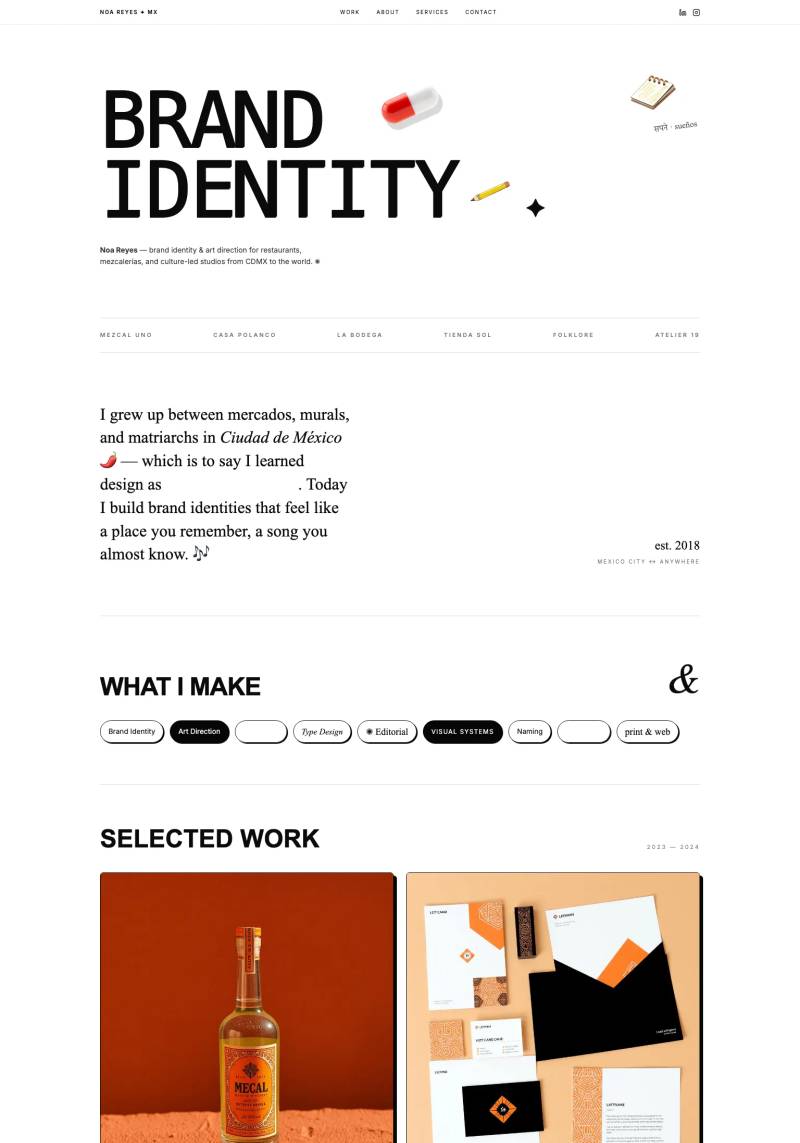
This brand identity portfolio introduces 3D objects floating through oversized typography and pairs pill-shaped service tags in mixed fill states to show editorial design depth.
 Mimic this
This proposal software site uses serif italics to emphasize key phrases—"and pricing," "faster," "brief to signed"—creating visual rhythm throughout the copy.
 Mimic this
This music production site uses blue waveform visualizations and stem mixers to showcase audio work, positioning composition as a technical, collaborative process.
 Mimic this
This financial forecasting site replaces spreadsheets with "Real-time cash flow, *without the* spreadsheet chaos" and syncs Stripe, Mercury, QuickBooks data into a runway metric.
 Mimic this
This sound design studio site uses an italicized, gold-accented word in the headline and a cursor-reactive waveform visualization as brand signatures.
 Mimic this
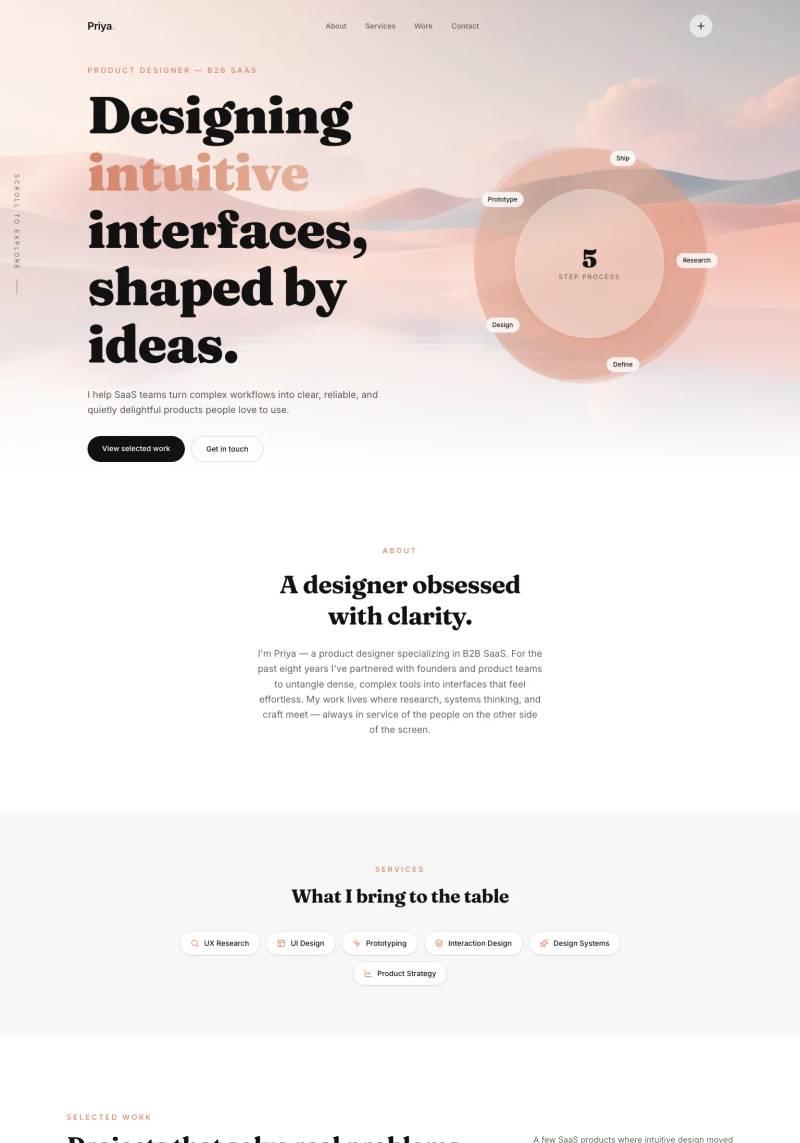
This product designer portfolio uses a dreamy peach-gradient hero with a 5-step orbital process diagram and italicized serif headings to anchor SaaS positioning.
 Mimic this
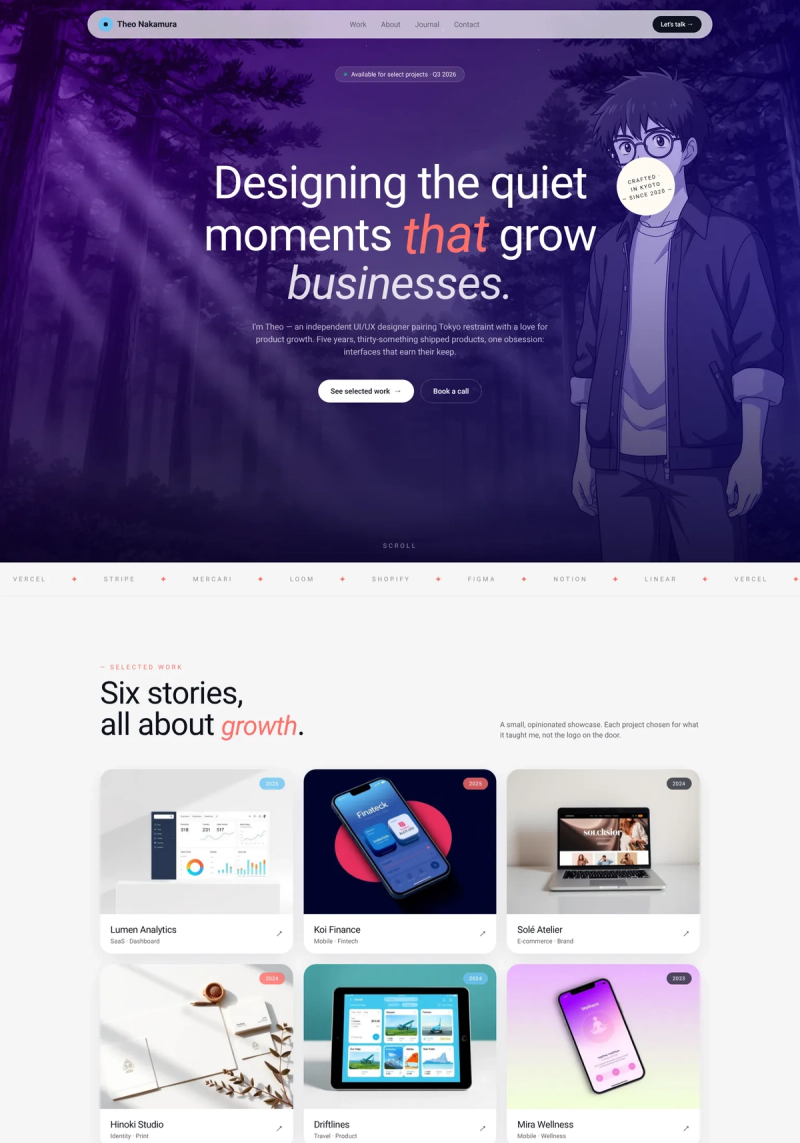
This product designer portfolio pairs a strikethrough headline ("Designing moments that grow businesses.") with a "STARTED IN A VERY DARK PLACE" sticker badge to signal unconventional thinking.
 Mimic this
This cash flow forecasting site emphasizes founder identity by italicizing "Bootstrapped" in the headline and repeating "stay in the green" as styled accent copy.
 Mimic this
This podcast production studio site uses italic serif accent words in headlines and emphasizes the audio player mockup as the hero visual.
 Mimic this
This copywriting studio site anchors its pitch with "Stories *people* actually want to read," italicizing and coloring that one word red to signal the human-centered difference.
 Mimic this
This developer tools studio site headlines its value with "Tools that *spin* the wheels of every developer," using italicized wordplay and vinyl record imagery to differentiate technical credibility.
 Mimic this
This brand identity portfolio positions scattered mood-board objects as interactive drag elements alongside "Identity that *actually moves*" in italic serif.
 Mimic this
This project management site illustrates the before/after of client briefs—messy chat bubbles transform into a structured proposal with scope, timeline, and budget.
 Mimic this
This photography portfolio leads with a hand-drawn mountain emoji in the headline and organizes selected work as gradient cards with centered geometric icons.
Design Data
The colors, fonts, and layout choices used across 131 Lovable websites.
Background color
How dark or light the page background is (background luminance).
- White / near white 83.7% (103)
- Black / near black 13.8% (17)
- Light 1.6% (2)
- Mid-tone 0.8% (1)
Accent color
The color of each site's primary button, measured from its code (accent hue family).
- Black, white & gray 41.7% (50)
- Amber / orange 30.8% (37)
- Red 8.3% (10)
- Blue 8.3% (10)
- Green 5.8% (7)
- Teal / cyan 2.5% (3)
- Purple 1.7% (2)
- Pink 0.8% (1)
Hero layout
How the top section arranges its headline and imagery.
- Text left, image right 30.5% (40)
- Text over a full-width image 27.5% (36)
- Centered text 19.1% (25)
- Text above full-width media 16% (21)
- Asymmetric 4.6% (6)
Hero imagery
The kind of visual the top section leads with.
- Photography 52.7% (69)
- Product screenshot 19.1% (25)
- No imagery 16% (21)
- Illustration 9.9% (13)
- 3D artwork 1.5% (2)
Button shape
Corner rounding on primary buttons (border radius relative to height).
- Rounded corners 57.6% (38)
- Pill (fully rounded) 33.3% (22)
- Square corners 9.1% (6)
Font combination
How heading and body typefaces pair (serif vs. sans-serif).
- Serif headings, sans-serif body 53.9% (41)
- All sans-serif 36.8% (28)
- All serif 5.3% (4)
- Monospace 3.9% (3)
Color intensity
How colorful the palette is, from black-and-white to bold color (saturation).
- Soft, muted color 55.3% (68)
- Black & white 41.5% (51)
- Bold, vivid color 3.3% (4)
Dark mode support
Sites whose code adapts to the visitor's light/dark preference (prefers-color-scheme).
- Yes 1.2% (1)
- No 98.8% (85)
Most-used fonts
The typeface each site leads with, read from its live CSS.
- Playfair Display 36.6% (26)
- Inter 16.9% (12)
- Fraunces 5.6% (4)
- Roboto 4.2% (3)
- Cormorant Garamond 4.2% (3)
Percentages are the share of sites where each trait could be measured, with counts in parentheses. Last updated August 2026.
Best Lovable website examples default to near-white, rarely to color
Among the best Lovable website examples, 83.7% of measured sites sit in the near-white background bucket, compared with 56% across the whole gallery. That gap is the single strongest signal on this page: Lovable builders are not experimenting much with tone, they are converging on bright, paper-white canvases and letting typography and photography carry the design. Custom Kitchens Factory, Half Off Mattress Outlet, and Hum Technologies all sit on white backgrounds, and each pairs that brightness with a photography-led or text-only hero rather than any background trickery. The near-black bucket exists too, at 13.8%, but it reads as a deliberate accent choice (see Luxury Style Braids and Al-Phoenix Ltd.) rather than a competing norm.
Vibrant color is nearly absent
Only 3.3% of measured sites land in the vibrant saturation bucket, four sites out of the full measured set, against 15.2% gallery-wide. Lovable sites lean muted (55.3%) or fully monochrome (41.5%) instead. That combination of near-white backgrounds and restrained saturation means color is doing almost no work: brands differentiate through type choice and photography, not hue. Ocean Gaze Beauty and Precise Cleaning Services both use muted palettes with a single accent color for buttons, which is the dominant formula here rather than the exception. Anyone building in this niche, especially inside Lovable SaaS Websites, should expect restraint to read as credibility rather than as a missed opportunity.
Heroes without imagery are twice as common here
Hero media reads “none” on 16% of sites here, versus 8.9% across the gallery, roughly one in six pages skipping a hero image or mockup entirely. That is a real jump, and it pairs with the fact that photo-led heroes still dominate overall at 52.7%. Hum Technologies, James Mercer, and Nashionista all run text-only heroes, favoring a strong headline and typographic hierarchy over a supporting image, a pattern worth studying inside Lovable Portfolio Websites where personal brands often prioritize the word over the picture.
Neutral and amber split the accent palette
Accent color splits between neutral at 41.7% and amber at 30.8%, with every other hue family in single digits. Honeycomb Home Services, Elliott Holland, and Mind Own Bu$ine$$ all use amber buttons against otherwise muted or black-and-white palettes, a formula visible across Lovable AI Websites as well. Rounded corners lead CTA shape at 57.6%, and Playfair Display leads the font list at 36.6%, reinforcing that the near-white, low-saturation, warm-accent combination is the house style of Lovable website design.