21 Best Ecommerce Tech Website Examples
I found the best tech website examples that attract top clients.
Tech sites win when they make complex products feel instantly understandable. These examples nail the balance between technical credibility and business clarity. Here’s what the best sites do:
- Lead with outcomes, not architecture. AI sites like Kurama Studios
cut through hype by showcasing “production-ready agents that deliver measurable business impact” while Dimension AI
promises to “instantly convert sketches into precise 3D models.” Your homepage isn’t a spec sheet. - Use design to signal technical competence. SaaS platforms like Juump
pair dark layouts with electric blue accents for that premium tech vibe, while Sparkle’s
clean split-screen hero and macOS screenshot prove the product works. Janky UI makes people question your code quality. - Build trust through progressive disclosure. EUrouterAI
uses trust badges and centered hero positioning for enterprise buyers, while Developer Tools like LLMagnet
balance soft lavender gradients with technical credibility. Serve
both evaluators and decision-makers without overwhelming either.
Check out the full gallery of tech websites below.
This professional camera accessories shop leads with full-width product photography, orange accent buttons, and a value proposition stating it "crafts premium camera and gimbal accessories designed to save operators time on set."
This indoor climate monitor site leads with a bird figurine perched on the product, then validates design credibility through Vogue, Wallpaper*, and designboom logos.
This coaching site pairs a dark navy hero with a woman reaching upward, uses "Live by design, not by default ✦" as a scrolling ticker, and anchors CTAs in gold pill buttons.
This nasal wellness DTC site leads with "The best gift is better breathing" and uses a horizontal logo marquee featuring CNN, Fox, and Men's Health.
This sales intelligence site sells lead qualification with "Stop chasing bad leads" and interactive UI cards showing scoring logic embedded in a gray feature container.
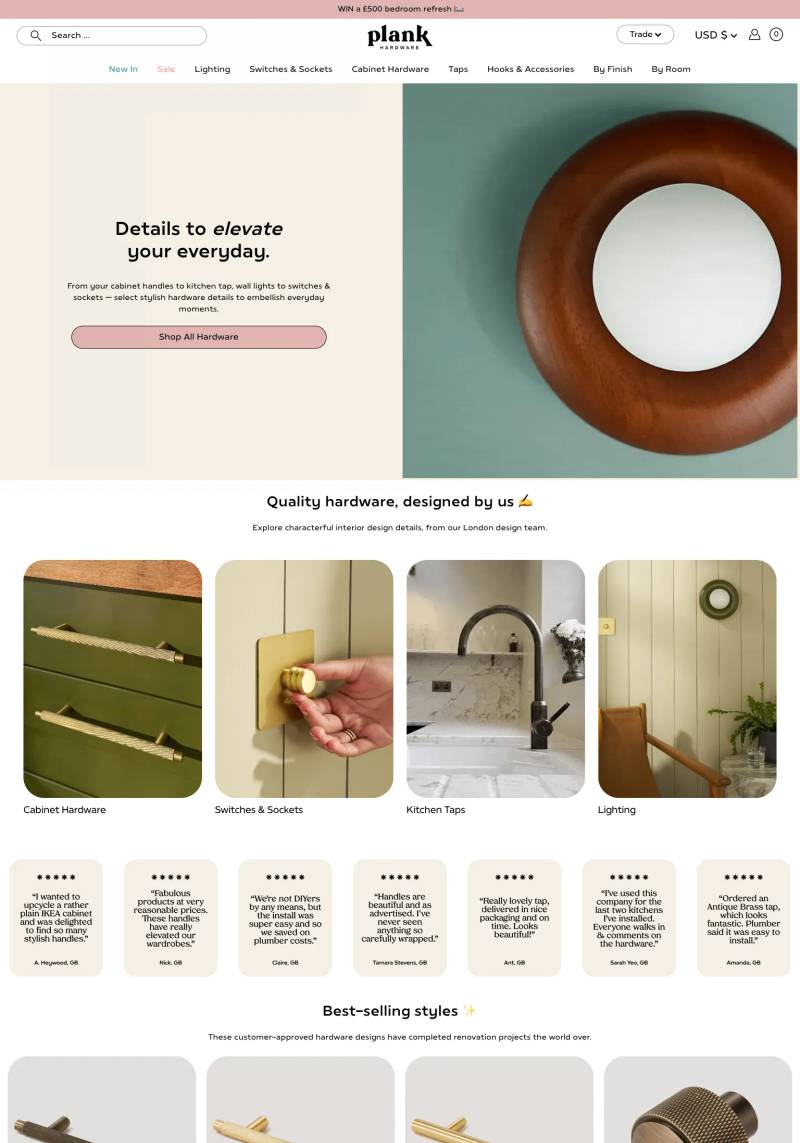
This hardware e-commerce site uses a split hero with "elevate" italicized in the headline and pairs blush pink with sage green to position functional products as interior design details.
This elder care tech site sells an AI companion through lifestyle photography of an older adult smiling at the device, with serif headlines and pill-shaped CTAs in salmon and green.
This security camera shop stacks trust badges in a scrolling bar below navigation, then leads with "SAVE 25% SITEWIDE" and strikethrough pricing on featured products.
This email marketing automation site opens with "It's time to break up with your platform if..." and uses magenta accent buttons paired with purple workflow mockups.
This audio retailer site pairs product photography with bold all-caps overlay copy like "BASS SO BIG IT HAS WHEELS" and "BORN TO BE WORN" over split-screen hero imagery.
This e-ink tablet marketplace site frames puzzles as "Handwritten Cognitive Workflow" and organizes products in monochrome line-art grid cards.
This card game pre-launch page uses isometric 3D cube characters and a "DROP SOON" watermark to build anticipation for a pixel-art matching game.
This electronics e-commerce site sells tech accessories through lifestyle photography of products held in hands, with inline bold keywords emphasizing "the latest" and "most advanced."
This tech accessories site uses a pixel-matrix typeface for all text and stacks full-viewport hero sections, each featuring a single product with "ONE TO POWER ALL" positioning.
This vinyl record cleaning product site highlights its three-step process—"Spray Wipe Play"—in oversized serif numerals alongside the product bottle on dark microfiber cloth.
This card game retailer uses yellow highlight blocks to break up black uppercase headlines line-by-line, emphasizing copy like "PLAY THE GREATEST GAME OF SOCIAL STRATEGY EVER CREATED, NOW FROM HOME!"
This football apparel shop pairs cinematic hero imagery of models in artistic jerseys against Roman landmarks with a rotating marquee announcing shipping thresholds across European regions.
Zeus
This smart lock e-commerce site leads with "World's FIRST fire rated facial recognition digital door lock" and sells the bundle price "$699" in the announcement bar.
This electronics accessories store uses full-width hero banners with dramatic product photography and stacked "Learn More" CTAs beneath left-aligned headlines.
This 3D printing shop organizes products across three distinct grids: colorful geometric renders, zodiac statues at uniform pricing, and architectural landmarks with photographic overlays.
What the Top 0.1% of Tech Websites Get Right
I analyzed these tech sites and found distinct patterns that separate the best from the rest.
Visual Identity: Dark Modes and Calculated Color Psychology
Tech brands have moved beyond basic dark themes to sophisticated visual strategies.
- Strategic dark backgrounds: About 75% use near-black (#0A0A0A) rather than pure black, with sites like BBN International and Dovetail creating depth through subtle gradients and grid overlays
- Accent color restraint: Epic Leap AI and LLMagnet limit themselves to 1-2 accent colors maximum, using orange (#E84E1B) and purple (#7C3AED) respectively as the sole brand differentiator against monochrome bases
- Typography mixing: Roughly 60% combine serif headings with sans-serif body text, like Lumoria and Create that life using script/calligraphy fonts for emotional connection while maintaining clean readability
→ Dark backgrounds aren’t just trendy anymore, they’re strategic canvases that make minimal accent colors pop with maximum impact.
Layout and UX: Hero-Heavy Architecture and Trust Signal Placement
These sites prioritize immediate visual impact over traditional navigation patterns.
- Viewport-dominant heroes: Nearly 80% dedicate 55-65% of viewport height to hero sections, with sites like Flycraft and Kaizen using this space for compelling value props rather than generic imagery
- Social proof positioning: Companies like TimezoneTracker and Fragment OS place customer counts and star ratings directly below CTAs rather than in separate sections, creating immediate validation
- Grid-breaking mockups: SaaS platforms like Dovetail and LeoAds use tilted, overlapping interface screenshots with subtle glows and shadows instead of flat, centered mockups
→ The hero section has become the entire sales pitch, with everything else serving as supporting evidence.
Copy and Messaging: Problem-First Headlines and Specificity Over Buzzwords
Tech copywriting has evolved from feature lists to pain point articulation.
- Pain-point headlines: About 70% lead with customer problems rather than solutions, like Epic Leap AI’s “Every Missed Call Is Lost Revenue” and Trinox’s “A CLEAR AI PLAN FOR YOUR BUSINESS”
- Quantified value props: Sites consistently include specific metrics, with Craft mentioning “fee-less access” and “tax advantaged” while emmyHealth promises “~40% avg savings”
- Anti-hype positioning: AI companies like Trinox explicitly counter industry noise with phrases like “without the hype” and “without the noise,” acknowledging customer skepticism
→ The best tech sites acknowledge customer pain before pitching solutions, using specificity as the antidote to AI and tech fatigue.
Tech websites are becoming more sophisticated in their restraint. The winners understand that in an oversaturated market, clarity and focused value propositions beat feature laundry lists every time.